
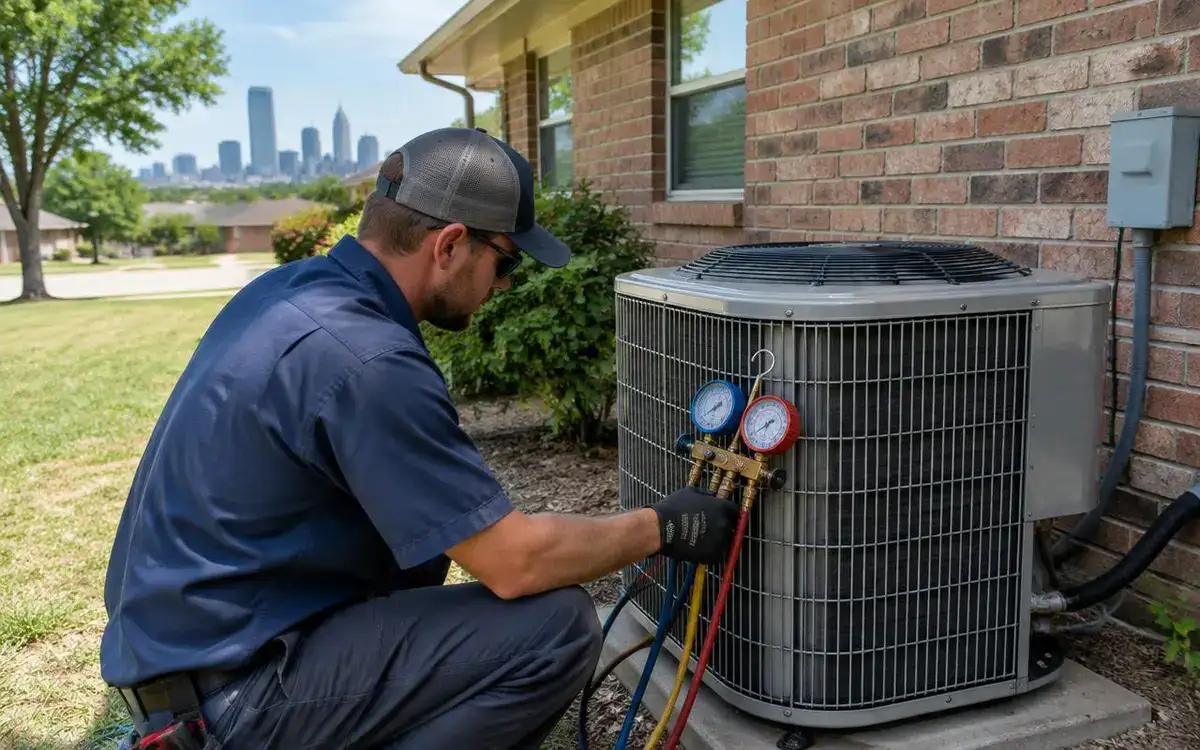
AC freezing up? Quick checks when you see ice
Ice usually forms on the indoor evaporator coil first, which is inside the air handler or furnace cabinet, and can spread to the copper refrigerant line outside once the problem has gone on for a while.
- Turn the thermostat to off and the fan to on. Running the compressor with ice on the coil makes the problem worse and can damage the compressor.
- Check the air filter. A filter clogged with dust is the single most common cause of AC freezing, since it starves the coil of airflow.
- Walk around the house and check that no vents are closed or blocked by furniture, rugs, or curtains; closed vents reduce airflow the same way a dirty filter does.
- Look at the outdoor unit for a kinked or disconnected refrigerant line, or listen for a hissing sound, which can point to a leak.
- Check the thermostat is not set unusually low, especially on a hot day when the system runs for hours without a break, since long runtimes with any airflow restriction speed up icing.
Indoor coil vs outdoor unit: two kinds of AC freezing up
Most AC freezing up starts at the indoor evaporator coil, above the furnace or air handler. Low airflow or low refrigerant lets the coil drop below 32°F, and humidity in the air turns to ice. Ice on the outdoor unit in summer usually starts at the suction line (the larger insulated copper pipe) and points to the same causes. Ice on a heat pump's outdoor coil in winter is normal for short periods and is not AC freezing up; the defrost cycle melts it. If a heat pump stays a solid block of ice, the defrost control has failed.
How long it takes to thaw, and whether to run the fan
- With AC freezing up, turn the thermostat to Off and the fan to On. Moving air over the coil speeds up thawing.
- Light ice clears in 1 to 3 hours. A solid block can take up to 24 hours.
- Watch the drain pan and condensate line. Melting ice makes far more water than normal and can overflow a clogged line.
- Do not chip the ice off an AC freezing up; coil fins bend and refrigerant tubes puncture easily.
- If AC freezing up comes back within a day or two of a new filter, low refrigerant or a weak blower is the likely cause and needs a technician.
Want a real price for your home?
Get a quoteHow to tell if ice is on the indoor or outdoor part
Ice on the indoor evaporator coil, found inside the air handler or furnace cabinet, is usually the first place freezing starts and can be hard to see without removing an access panel. Ice that has spread to the outdoor copper refrigerant line, visible without opening anything, usually means the problem has been going on for a while before anyone noticed.
If you can see frost on the outdoor line but have not checked the indoor coil, assume the indoor coil is iced over too and follow the same thaw process for the whole system.
Humidity's role in Tulsa-area AC freezing
High humidity common in Oklahoma summers means more moisture is pulled from the air by the coil, and that moisture turns to ice fastest when airflow across the coil is already restricted. A home that feels muggy even with the AC running, alongside visible ice, often points to both a humidity load and an airflow problem happening together.
Attic and crawlspace ductwork and freezing risk
- Leaky supply ducts in a hot attic reduce the volume of air actually reaching the coil, worsening airflow problems that lead to freezing.
- Disconnected or crushed flex duct in a crawlspace has the same effect as a dirty filter: less air moving across the coil.
- Homes with long duct runs to upstairs bedrooms sometimes freeze at the coil even while upstairs rooms stay warm, a sign of a duct airflow imbalance rather than refrigerant.
- A yearly duct inspection catches disconnected or crushed sections before they contribute to a freeze-up.
How often AC freezing recurs without a fix
A freeze caused only by a dirty filter typically does not return once the filter is replaced and airflow is restored. A freeze caused by low refrigerant from a leak will return within days to weeks if refrigerant is simply topped off without locating and sealing the leak itself.
Causes and fixes
| Cause | Fix | Typical cost |
|---|---|---|
| Dirty air filter | Replace the filter | $15 – $30 |
| Closed or blocked vents | Open vents and clear furniture away from them | $0 |
| Dirty evaporator coil | Professional coil cleaning | $150 – $400 |
| Low refrigerant from a leak | Leak detection, repair, and recharge | $250 – $1,500+ depending on leak location |
| Failing blower motor or weak fan speed | Replace blower motor or capacitor | $200 – $600 |
| Thermostat set too low with long runtimes | Raise the set temperature, add a programmable schedule | $0 – $200 for a new thermostat |
| Running the AC in cool weather below about 60°F outside | Avoid running AC when outdoor temps are low; use the fan only setting instead | $0 |
Why short-cycling can also cause freezing
A system that turns on and off rapidly, known as short-cycling, does not run long enough to properly dehumidify the air passing over the coil, which can lead to excess moisture freezing on the coil surface. Causes include an oversized AC unit for the home's square footage, a failing thermostat, or electrical contact issues in the outdoor unit.
Cost comparison: DIY fixes vs professional diagnosis
| Situation | DIY cost | Professional cost |
|---|---|---|
| Dirty filter only | $15 – $30 for a new filter | $0, you can do this yourself |
| Blocked vents | $0 | $0, you can do this yourself |
| Suspected refrigerant leak | Not DIY-safe | $250 – $1,500+ for detection and repair |
| Dirty coil restricting airflow | Not effective with household cleaners | $150 – $400 for professional cleaning |
Step-by-step: what to do when you find ice
- Step 1: Set the thermostat system switch to off, and the fan switch to on. This stops the compressor and lets the fan circulate air to help melt the ice.
- Step 2: Leave the fan running for 2 to 4 hours, or until you no longer see or feel ice on the indoor coil or the outdoor line.
- Step 3: While it thaws, place towels under the indoor air handler or furnace, since melting ice drips and can soak flooring or a finished ceiling below.
- Step 4: Replace the air filter if it is dirty, even if it looks only moderately dusty; airflow problems add up gradually.
- Step 5: Once fully thawed and the filter is replaced, switch the thermostat back to cool and set it a few degrees above the current indoor temperature rather than far below it.
- Step 6: Watch the system for the next hour. If ice starts forming again quickly, turn it back off and call a technician rather than repeating the cycle.
Safety warnings
Never try to chip, scrape, or pry ice off the coil or refrigerant lines. The coil fins are thin aluminum and bend or puncture easily, and a punctured coil means a full coil replacement instead of a simple cleaning.
Do not add refrigerant yourself. Refrigerant used in home AC systems is regulated, requires EPA certification to purchase and handle, and the wrong type or amount can damage the compressor.
Keep the thermostat off while ice is present. Running the compressor against a frozen coil restricts refrigerant flow and can cause liquid refrigerant to return to the compressor, which can cause expensive compressor damage.
If you see oily residue near a refrigerant line fitting, this often marks a leak point; do not attempt to tighten or handle these fittings, since refrigerant lines hold pressure even when the system is off.
When to call a pro
Call an HVAC technician if ice returns after you have replaced the filter and cleared vents, if you notice a hissing sound near the outdoor unit, if the system is low on cooling even without visible ice, or if ice formed with no obvious airflow problem. These point to a refrigerant leak or a coil issue that needs gauges and leak-detection tools to diagnose correctly.
A refrigerant leak will not fix itself and tends to get worse over a season. Topping off refrigerant without finding and repairing the leak is a short-term fix that costs more over time.
What a technician checks on a frozen AC call
- Airflow across the coil, measured with a static pressure test, to rule out duct or filter restrictions.
- Refrigerant charge and pressures with gauges, compared to the system's specified levels.
- Leak detection using an electronic sniffer or UV dye if refrigerant is low.
- Coil cleanliness, and a chemical coil cleaning if buildup is restricting heat transfer.
- Blower motor speed and capacitor condition, since weak airflow from a struggling motor can also cause freezing.
- Thermostat wiring and settings if the system is short-cycling or running excessively long.
Prevention
- Replace the AC filter every 1 to 3 months during cooling season, more often with pets or during high pollen weeks.
- Schedule a spring tune-up before peak summer heat, which checks refrigerant charge and cleans the coil before problems start.
- Keep all vents open and unblocked by furniture, even in rooms you use less.
- Keep the outdoor condenser unit clear of grass clippings, leaves, and at least 2 feet of open space on all sides for airflow.
- Do not run the AC when outdoor temperatures drop below about 60°F; use the fan-only setting instead, since very low outdoor temps combined with AC operation increase freezing risk.
Why summer heat here makes this worse
Summers regularly top 95°F with high humidity, which pushes AC systems to run long cycles for weeks at a time. Long runtimes turn a small airflow restriction, like a filter that is a few weeks overdue, into a full freeze far faster than in a mild climate. Homes with attic-mounted air handlers see this especially often, since attic temperatures above 120°F in July and August stress the whole system and make any existing weakness in airflow or refrigerant charge show up sooner.
If the frozen coil turns out to be a refrigerant leak, ask whether the coil is still under the manufacturer's parts warranty, which often runs 10 years when the system was registered.
Next steps for Tulsa homeowners
- Ready to fix it? AC repair in Tulsa — a licensed local pro calls back with a price.
- See emergency AC repair.
- See AC tune-up.
- See our AC repair cost guide.
Questions Tulsa homeowners ask
Can I keep running my AC while it has ice on it?
No. Running the compressor with a frozen coil restricts refrigerant flow and can damage the compressor, which is a far more expensive repair than the original cause.
How long does it take for a frozen AC coil to thaw?
With the fan running and the compressor off, most coils thaw in 2 to 4 hours, though a heavily iced coil can take longer.
Is a frozen AC always a refrigerant problem?
No. A dirty filter or blocked vents causes freezing just as often as low refrigerant. Check airflow issues first before assuming a leak.
How much does it cost to fix a refrigerant leak?
Leak detection and repair ranges from $250 for an accessible fitting to $1,500 or more if the leak is in the evaporator coil itself and the coil needs replacement.
Will a dirty filter really cause ice to form?
Yes. A clogged filter is the most common cause of AC freezing because it reduces airflow across the coil, which drops the coil temperature below freezing.
Should I add refrigerant myself if I have some at home?
No. Home AC refrigerant is regulated and requires EPA certification to purchase and handle. Adding the wrong amount or type can damage the system.
How often should I change my AC filter in summer?
Every 1 to 3 months during heavy use is typical, with more frequent changes if you have pets or run the system almost continuously in peak summer heat.