
Leak detection before buying a home
Slab leaks and failing yard lines are common in older Tulsa subdivisions. Before closing on a home built before 1990, ask for a meter test and a look at the last 12 months of water bills. If the meter dial moves with everything off, ask for leak detection before you sign.
Want a real price for your home?
Get a quoteInsurance claims for leak damage
Many Oklahoma homeowners policies cover sudden water damage, like warped flooring or wet drywall from a leak, but not the cost of finding or fixing the pipe itself. Photograph damage right away, keep the water bill showing the usage spike, and call your insurer before repairs begin so an adjuster can see the damage.
Ask the leak detection company for a written report describing the leak location and likely cause; adjusters often request this document.
False leak signs to rule out first
Ruling these out first can save the cost of a detection visit for something a five-minute check could find.
- Condensation from an AC supply line in a wall can mimic a water leak stain.
- A running toilet can raise your water bill as much as a slab leak; check the flapper first with the dye test.
- An irrigation controller stuck on can run water for hours unnoticed.
- A dripping outdoor spigot left slightly open adds up over a billing cycle.
Acoustic listening discs vs thermal imaging
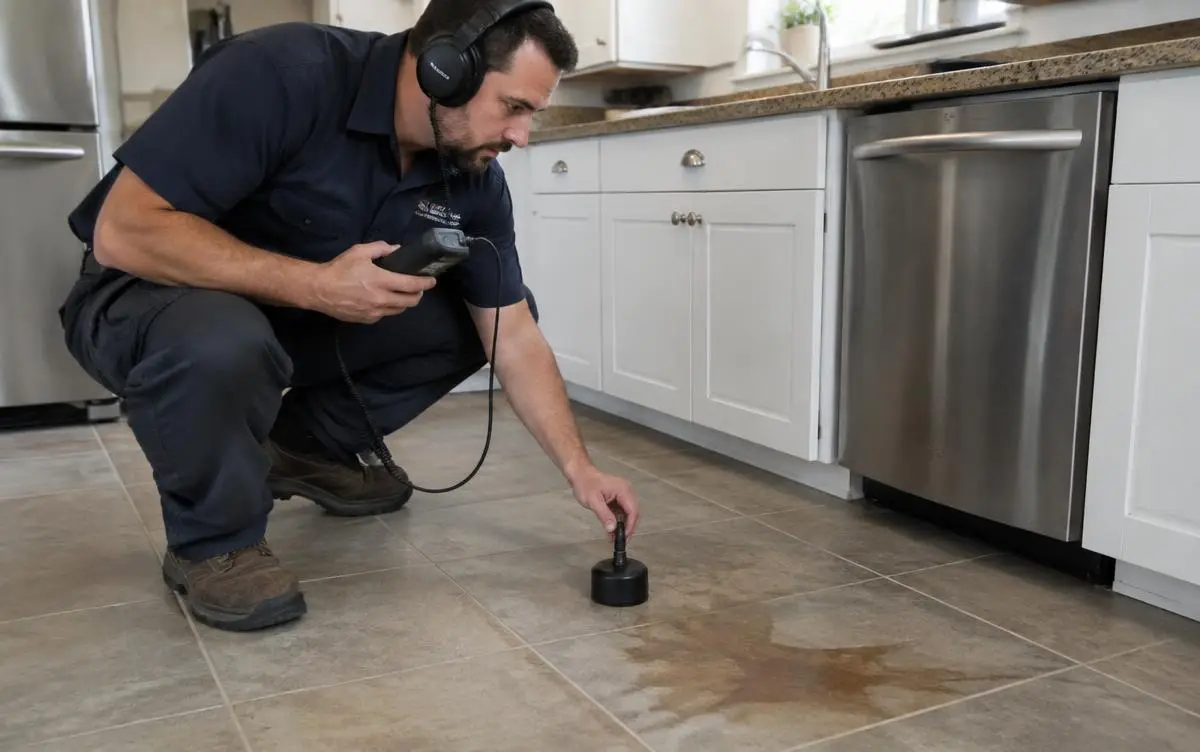
An acoustic listening disc presses against the floor or wall and amplifies the faint hiss of water escaping a pressurized line, letting a technician narrow a slab leak to within a foot or two. It works best at night or early morning when household noise is low.
A thermal camera reads surface temperature instead of sound. A hot water leak under a slab warms the floor above it by a few degrees, showing up as a bright patch on the camera screen within 10 to 20 minutes of the leak starting to run.
- Acoustic disc: fast, works on concrete and pipe insulation, needs a quiet room.
- Thermal camera: best for hot water lines, does not confirm cold water leaks as well.
- Tracer gas: a nontoxic hydrogen-nitrogen mix pushed through the empty pipe, then sniffed out where it escapes through the slab.
- Combining two methods narrows a leak location to a few inches before any concrete gets cut.
Reading your ONG and water bill together
A hidden hot water leak shows up on two bills at once: the City of Tulsa water bill climbs from the extra flow, and the ONG gas bill climbs because the water heater runs longer to keep up. Comparing both bills side by side for the same month often points to a hot line leak before a plumber ever opens a wall.
A cold water leak only raises the water bill. If the water bill jumps but the gas bill stays flat, the leak is more likely on a cold supply line, an irrigation line, or a running toilet flapper.
How to check for a leak with your water meter
- Turn off every faucet, toilet, the washer, ice maker and irrigation.
- Find the meter in the curb box near the street and lift the lid.
- Look at the small leak indicator (a triangle or star) on the dial.
- If it turns, water is leaking somewhere after the meter.
- Close your main house valve. If the dial stops, the leak is inside the house. If it keeps turning, the leak is in the yard line.
Leak detection cost in Tulsa
| Job | Typical range |
|---|---|
| Leak detection visit | $250 – $500 |
| Slab leak detection | $300 – $600 |
| Wall leak repair (open, fix, patch) | $300 – $1,000 |
| Slab leak repair through the floor | $1,500 – $4,000 |
| Slab leak reroute (new line above slab) | $2,000 – $5,000 |
| Yard water line repair | $600 – $2,500 |
Picking a leak detection company
- Confirm they carry acoustic and thermal equipment, not just a camera.
- Ask how they will mark the found leak location before any opening is made.
- Ask for a written estimate of the repair before they cut into a wall or slab.
- Ask whether the detection fee applies toward the repair cost if you hire them.
- Check Oklahoma plumbing license status on the CIB site.
Tools a plumber uses to find leaks
- Pressure test: each line is isolated and held under pressure to see which one loses it.
- Acoustic listening: ground microphones pick up the hiss of water escaping a pipe under concrete.
- Thermal camera: shows warm water spreading under floors and inside walls.
- Line tracer: maps where pipes run under the slab so the plumber opens the right spot.
- Moisture meter: confirms wet drywall or subfloor before anything is cut.
Why slab leaks are common in Tulsa
Most Tulsa homes built after the 1960s sit on a concrete slab with copper or PEX water lines under it. Tulsa's expansive clay soil swells in wet springs and shrinks in dry summers. That movement rubs pipes against concrete and gravel until a pinhole forms.
Hot water lines leak more often than cold lines because heat makes the copper expand and contract each day. A warm floor spot is the classic sign.
Common places leaks hide in Tulsa homes
Toilets are the easiest to check yourself. Put 10 drops of food coloring in the tank and wait 15 minutes without flushing. If color shows up in the bowl, the flapper is leaking. A new flapper costs under $15.
- Under the slab, on hot water lines feeding the kitchen and bathrooms.
- Behind the shower valve in a shared wall.
- Toilet flapper valves, which leak silently into the bowl.
- Water heater connections and the T&P valve discharge pipe.
- Ice maker and dishwasher supply lines behind cabinets.
- Irrigation lines and backflow devices in the yard.
- The main yard line between the meter and the house.
Repair options after the leak is found
For a single pinhole in an otherwise good line, the plumber can open the slab at that spot and repair it. For older copper with more than one leak, a reroute runs a new PEX line through the attic or walls and abandons the old line under the slab. A reroute often costs about the same and avoids future slab leaks on that line.
Yard line leaks are dug up and repaired with new pipe from the meter to the house. Many Tulsa homes from the 1970s and 1980s have polybutylene (gray plastic) lines, which fail often and should be replaced.
After a slab leak is repaired
Once a pinhole leak is fixed or a line is rerouted, keep an eye on your next two water bills to confirm usage returned to normal. Flooring damaged by a hot water slab leak, like warped wood or lifted tile, often needs separate repair from a flooring contractor, which is usually a different cost than the plumbing bill.
What happens after the leak location is marked
- The technician marks the exact spot with spray paint or chalk and gives a written report with photos.
- You get the report before agreeing to any repair, so a second plumber can bid the fix if you want a second opinion.
- Access options include cutting a small slab section, rerouting the line through the attic, or abandoning the leaking run and running new pipe overhead.
- Ask whether the detection fee is credited toward the repair cost if you hire the same company to fix it.
What to do right now
If water is visible or the bill is climbing fast, close the main house valve to stop damage. Take photos of wet areas for insurance. Many policies pay for water damage from a sudden leak but not the pipe repair, so ask your insurer what they cover.
Leak detection service area
Plumbers in this network find leaks across Tulsa, including South Tulsa, Midtown and Brookside, plus Broken Arrow, Owasso, Bixby, Jenks and Sand Springs.
If the detection visit leads to a repair, ask whether the detection fee is credited to the repair price and how long the repair is under warranty.
Before you book: Tulsa price and problem guides
- Read the slab leak signs.
Next steps for Tulsa homeowners
- See slab leak repair.
- See whole-house repiping.
- See slab leak repair cost.
Questions Tulsa homeowners ask
How much does leak detection cost in Tulsa?
Most visits cost $250 to $500. Slab leak detection runs $300 to $600 because it needs acoustic and tracing tools.
Does insurance pay for leak detection?
Some policies cover the cost to find the leak and the water damage, but not the pipe repair. Call your insurer with your policy number.
How long does leak detection take?
Most visits take 1 to 3 hours. Slab leaks can take longer when more than one line needs testing.
Can a leak be found without breaking walls?
Yes. Acoustic and thermal tools point to the leak first, so the plumber opens only one small spot.
Is a slab leak an emergency?
A hot water slab leak can crack flooring and raise your bill fast. Close the main valve or the water heater's cold supply and book a visit within days.
Who fixes a leak before the meter?
A leak between the street and the meter belongs to the City of Tulsa. Call 311 to report it.