
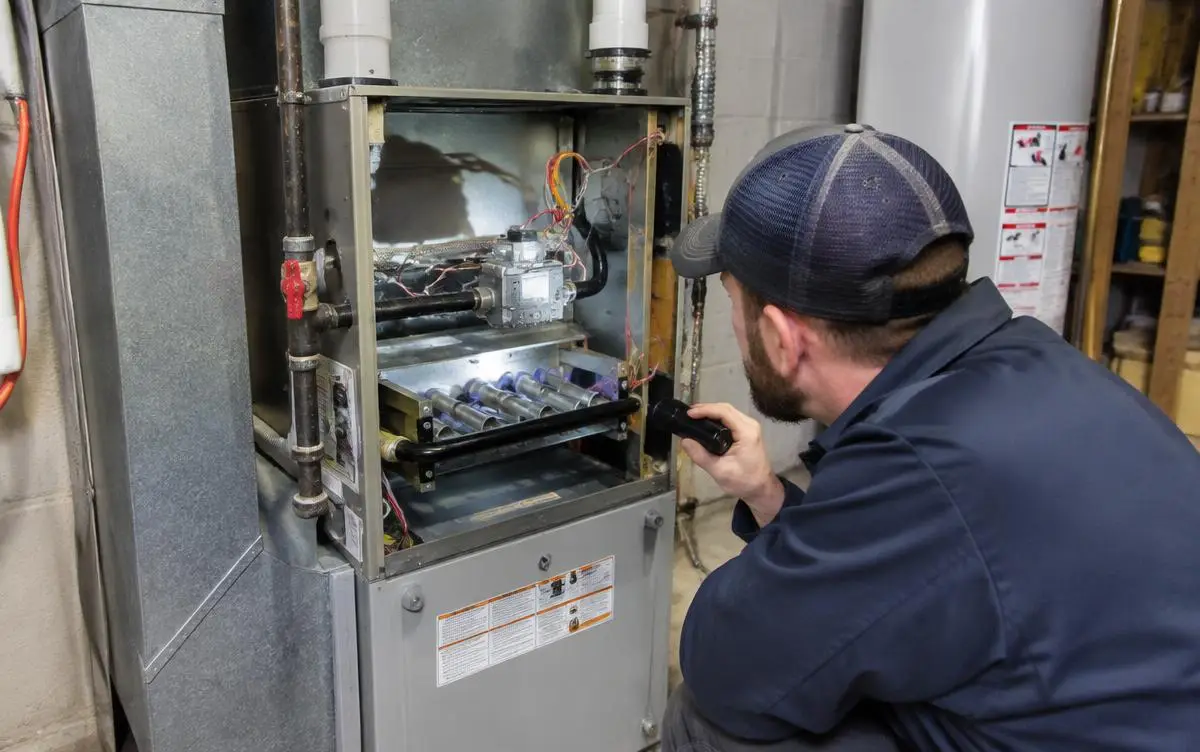
Signs your furnace needs repair
- The furnace clicks, the igniter glows, but the burners never light.
- Burners light, then shut off after 3 to 10 seconds. This is often a dirty flame sensor.
- The blower runs but the air from the vents is cold.
- A blinking light on the control board. The code chart is inside the panel door.
- Loud squeal, bang or rattle when the furnace starts.
- Yellow burner flames instead of blue, or soot near the burners.
- The carbon monoxide alarm sounds. Leave the house and call ONG at 1-800-458-4251.
Furnace error codes
Most furnaces built after 2000 have a small LED on the control board that blinks a code. Count the blinks and match them to the chart on the inside of the furnace door. Common meanings:
- Pressure switch open: blocked vent, failed inducer motor or clogged condensate trap.
- Flame sense failure: dirty flame sensor or poor ground.
- Ignition lockout: furnace tried 3 times and failed to light.
- Limit switch open: overheating, often from a clogged filter or closed vents.
- Rollout switch tripped: flame rolled out of the burner box. Do not reset this; call a technician.
80% vs 95% furnaces
An 80% furnace turns 80 cents of every gas dollar into heat and vents through a metal flue. It costs less and fits most older Tulsa homes. A 95% furnace turns 95 cents into heat and vents through PVC pipe out a side wall or roof. It needs a condensate drain.
For a typical Tulsa winter, the gas savings of a 95% unit are smaller than in northern states. Many installers suggest an 80% unit in an attic and a 95% unit in a closet or basement where the drain is easy.
Want a real price for your home?
Get a quoteFall furnace tune-up checklist
- Replace the filter.
- Clean the flame sensor and inspect the igniter.
- Check gas pressure and burner flame color.
- Inspect the heat exchanger for cracks.
- Test the limit, rollout and pressure switches.
- Clear the condensate trap on 95% units.
- Check the flue for rust, gaps and correct slope.
- Test carbon monoxide levels near the furnace.
How to vet a furnace repair technician
- Ask for the Oklahoma HVAC license number and confirm it with the Construction Industries Board.
- Ask if diagnosis fee applies toward the repair if you approve the work.
- Get the parts and labor price in writing before the repair starts.
- Ask about the labor warranty length on the specific repair.
- Ask whether they checked the heat exchanger for cracks as part of the diagnosis, since a cracked exchanger is a carbon monoxide risk.
Furnace repair vs replacement by age
Most gas furnaces in Tulsa last 15 to 20 years with yearly maintenance. A major component failure, like a cracked heat exchanger or failed control board, on a furnace already past 15 years usually costs more to fix than to put toward a new, more efficient unit.
| Furnace age | Repair under $300 | Repair over $1,000 |
|---|---|---|
| 0 – 8 years | Repair | Repair, likely under warranty |
| 9 – 15 years | Repair | Compare to replacement cost |
| 16+ years | Repair if minor | Usually replace |
What a furnace tune-up receipt should show
- Date of service and technician name.
- Filter replaced or inspected, with the size noted.
- Flame sensor cleaned, igniter inspected.
- Gas pressure and burner flame checked.
- Heat exchanger inspected for cracks.
- Carbon monoxide reading near the unit.
Draft inducer motor failure
The draft inducer motor spins a small fan that pulls exhaust gas out of the furnace before the burners are allowed to light, a safety step on every modern furnace. When this motor wears out, bearings or control board, the furnace often clicks and shuts down without ever lighting, throwing a pressure switch fault code.
A draft inducer motor replacement runs $250 to $500 including labor. A new pressure switch alone, if the motor still works but the switch fails to sense draft, runs $150 to $300.
Secondary heat exchanger cracks in 90%+ furnaces
- High-efficiency furnaces (90% AFUE and above) use a secondary aluminum heat exchanger that condenses flue gas to pull out extra heat.
- Condensate is mildly acidic and can corrode a weak weld or seam after 12 to 18 years of use.
- A cracked secondary exchanger shows up as a slow condensate leak, a gurgling sound, or a failed combustion test.
- Replacement parts run $600 to $1,200; many homeowners choose to replace the furnace instead once it is past 15 years old.
Thermostat wiring mistakes that look like a broken furnace
A loose or miswired thermostat wire at the furnace control board can mimic a dead furnace: no heat, no fan, no response to the thermostat. Common culprits are a C-wire (common wire) that was never connected on an older system now running a smart thermostat, or a wire nicked during a DIY thermostat swap.
Before paying for a service call, check that the thermostat display is lit and the breaker labeled furnace is on. If the thermostat screen is blank, the furnace itself may still be fine.
Flame sensor cleaning
- The flame sensor is a thin metal rod near the burners that confirms the flame is actually lit before letting gas keep flowing.
- A coated or corroded flame sensor causes the furnace to light, run for a few seconds, then shut off, often repeating several times before locking out.
- Cleaning the sensor with fine sandpaper or steel wool is a 10-minute fix a technician can do on a routine repair visit.
- A flame sensor cleaning or replacement typically costs $100 to $200 as part of a service call.
No heat on a freezing night: what to do before furnace repair arrives
- Set the thermostat to Heat and 5 degrees above room temperature, then wait 3 minutes. Many furnaces wait 30 to 90 seconds before the burners light.
- Check the furnace switch (it looks like a light switch on or near the unit) and the breaker in the panel.
- Open the furnace door panel only to read the blinking LED code; the code list is printed inside the door. Tell the technician the code when you book furnace repair.
- If other gas appliances also do not work, call Oklahoma Natural Gas (ONG) first. A gas supply problem at the meter is ONG's job, not a furnace repair.
- Run faucets at a slow drip and open cabinet doors under sinks on outside walls if the house will drop below 55 degrees.
- Use space heaters on a hard floor, 3 feet from beds and curtains, plugged directly into a wall outlet.
How to compare furnace repair companies in Tulsa
Most of the companies ranking for furnace repair in Tulsa list a flat diagnostic fee, usually $79 to $149, that is credited toward the repair if you approve it. Ask for that fee in writing on the phone. Ask whether the technician carries common parts (igniters, flame sensors, inducer motors, capacitors) on the truck, because a second trip for a part adds a day without heat.
Check that the company holds an Oklahoma Construction Industries Board mechanical license. Before approving furnace repair over $1,000 on a furnace older than 15 years, ask for a replacement quote too, so you can compare both numbers.
Quick checks before you call
- Thermostat set to Heat and at least 3°F above room temperature, with fresh batteries.
- Furnace power switch on (it looks like a light switch near the unit).
- Breaker in the panel not tripped.
- Furnace filter not clogged. A blocked filter trips the high-limit switch.
- Gas valve handle in line with the pipe (open).
- Outdoor intake and exhaust pipes on high-efficiency furnaces not blocked by snow or ice.
Furnace repair cost in Tulsa
| Repair | Typical range |
|---|---|
| Diagnostic visit | $80 – $150 |
| Flame sensor clean or replace | $100 – $250 |
| Hot surface igniter | $150 – $450 |
| Pressure switch or inducer motor | $250 – $900 |
| Blower motor | $450 – $1,200 |
| Control board | $400 – $900 |
| Gas valve | $400 – $900 |
Common furnace parts and typical repair cost
These are typical parts-and-labor ranges in the Tulsa area; your technician's written quote after diagnosis is the number to rely on, since brand and furnace model change part prices.
| Part | Typical repair cost |
|---|---|
| Igniter | $150 – $350 |
| Flame sensor (clean or replace) | $100 – $250 |
| Inducer motor | $300 – $650 |
| Blower motor | $350 – $750 |
| Control board | $300 – $700 |
| Gas valve | $300 – $600 |
Igniter types and typical replacement cost
Older furnaces use a standing pilot light that stays lit all the time; most furnaces installed since the late 1990s use a hot surface igniter, a small ceramic rod that glows and lights the gas when the thermostat calls for heat. A hot surface igniter is fragile and typically lasts 5 to 8 years before the ceramic cracks from repeated heating and cooling cycles.
A hot surface igniter replacement runs $150 to $300 including labor. An older style pilot light and thermocouple repair, when the pilot blows out or will not stay lit, runs $100 to $250.
Common furnace problems in Tulsa homes
Tulsa furnaces sit idle from May to October. Dust settles on the flame sensor and igniter, so the first cold night in November brings a wave of no-heat calls. A fall tune-up catches most of these.
Attic furnaces, common in Tulsa ranch homes, run in 120°F summer heat when they share a cabinet with the AC coil. That heat wears out wiring, capacitors and blower motors faster than in a closet unit.
How furnace repair works
- The technician reads the error code and checks thermostat, power, gas and filter.
- Gas pressure, flame sensor current, igniter resistance and limit switches are tested.
- The heat exchanger is inspected for cracks, which can leak carbon monoxide.
- You get a written price for the part and labor.
- The part is replaced and the furnace is run through 2 or 3 full heat cycles.
Repair or replace your furnace
Gas furnaces usually last 15 to 20 years. Repair if the furnace is under 12 years old and the part is a sensor, igniter, switch or board. Replace if the heat exchanger is cracked, the furnace is over 18 years old and needs a blower or gas valve, or repairs this season already passed $1,000.
A new furnace in Tulsa costs $3,500 to $7,000 installed. An 80% efficient unit costs less; a 95% unit saves gas but needs PVC venting.
Furnace safety
Every Tulsa home with a gas furnace should have a carbon monoxide alarm on each floor. If you smell gas, do not flip switches. Leave the house and call ONG from outside. Do not try to repair a gas valve or heat exchanger yourself.
Carbon monoxide safety with a gas furnace
A cracked heat exchanger can leak carbon monoxide into the home's air supply. Every Tulsa home with a gas furnace should have a working carbon monoxide detector on each level, tested monthly with fresh batteries twice a year. Symptoms of CO exposure include headache, dizziness and nausea that improve when you leave the house.
If a detector alarms, leave the house immediately, call 911 or the gas company, and do not re-enter until it is confirmed safe. ONG's gas emergency line is 1-800-458-4251 for any gas smell or suspected leak.
Furnace repair service area
Technicians in this network serve Tulsa, Broken Arrow, Owasso, Bixby, Jenks and Sand Springs. During a cold snap or ice storm, choose Today in the form so the job is flagged as urgent.
Next steps for Tulsa homeowners
Questions Tulsa homeowners ask
How much does furnace repair cost in Tulsa?
Most repairs cost $150 to $700. Blower motors, gas valves and control boards cost more, up to about $1,200.
Why does my furnace turn on then off?
A dirty flame sensor is the most common cause. It costs $100 to $250 to clean or replace. A clogged filter or blocked vent can do the same.
Is it safe to run a furnace with a cracked heat exchanger?
No. A cracked heat exchanger can leak carbon monoxide into the house. Turn the furnace off and have it replaced.
How often should a furnace be serviced?
Once a year, ideally in September or October before the first cold night.
Can you repair a furnace the same day?
Often yes, when the technician carries the part. Common parts like igniters and flame sensors are usually on the truck.
Should I repair my heat pump instead?
If your home uses a heat pump for heat, the problem may be in the outdoor unit. Mention this in the form so the right technician calls.