
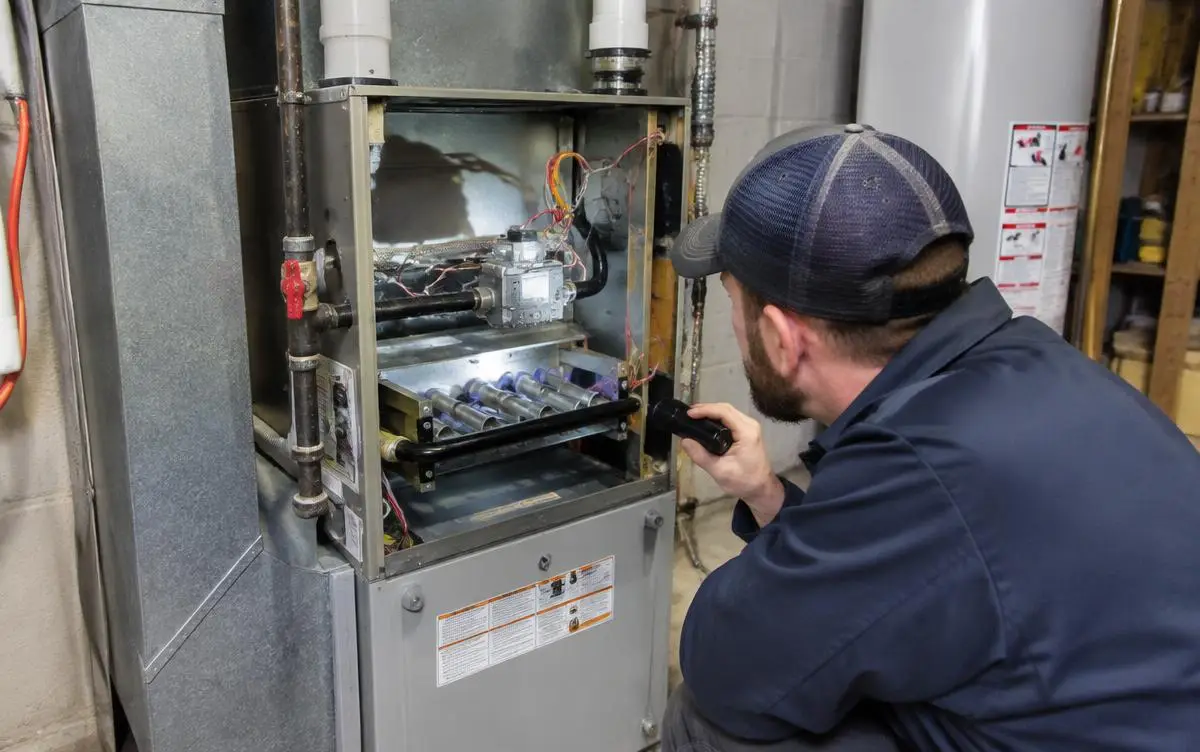
Signs your heat pump needs repair
- Air feels cool rather than warm in heating mode, even though the system runs.
- Heavy ice on the outdoor unit that does not clear during a normal defrost cycle.
- The system runs nonstop without reaching the set temperature.
- Loud clicking when switching between heating and cooling, which can point to a failing reversing valve.
- The emergency or auxiliary heat strip runs constantly, which drives up electric bills.
- Short cycling: the unit turns on and off every few minutes.
What the Emergency Heat setting does
Most heat pump thermostats have an Emergency Heat (EM Heat) setting. It turns off the outdoor unit and runs only the electric heat strips inside the air handler. Use it only when the outdoor unit needs heat pump repair, iced solid for hours or damaged by a storm, and book heat pump repair the same day.
Until heat pump repair is done, heat strips use 2 to 3 times more electricity than the heat pump itself. A Tulsa home left on Emergency Heat for a January week can add $80 to $200 to the PSO bill. If the thermostat shows Aux Heat during normal cold mornings, that is normal; if Aux Heat stays on all day above 35°F, the heat pump needs repair.
Dual-fuel system troubleshooting
In a dual-fuel setup pairing a heat pump with a gas furnace, a changeover thermostat switches to the furnace below a set outdoor temperature, often around 35°F. If the home still feels cold on a mild day, check whether the changeover temperature is set too low, keeping the less efficient heat pump running on a day the furnace would heat faster.
A technician can adjust the changeover point based on the specific heat pump's efficiency rating and the home's insulation, rather than leaving a generic factory setting in place.
Want a real price for your home?
Get a quoteElectric bill spikes during cold snaps
During the February 2021 cold wave and similar hard freezes, heat pumps across Tulsa leaned heavily on electric auxiliary heat strips, which can use 10 to 15 kilowatts compared to roughly 3 to 5 kilowatts for the compressor alone. A single week of aux-heat-heavy weather can add well over $100 to a PSO bill for an average home.
If a utility bill spikes sharply after a cold snap, that alone does not mean something is broken; it may simply reflect normal aux heat use during temperatures the heat pump cannot handle efficiently on its own.
Noise diagnosis specific to heat pumps
- A loud clunk when switching between heating and cooling: often the reversing valve shifting position.
- Continuous rattling from the outdoor unit: loose panel screws or debris caught in the fan.
- A hissing sound after the system shuts off: refrigerant equalizing, usually normal.
- Grinding from the outdoor fan: a failing fan motor bearing.
When a heat pump repair isn't worth it
A heat pump compressor failure on a system older than 10 years, combined with a prior repair in the last two years, is a signal to price a full replacement alongside the repair. Compressor replacement alone often runs $1,800 to $3,000, which can approach half the cost of a new matched system once labor is included.
Ask the technician for both numbers side by side, repair cost and new install cost, before deciding, especially since a new system also comes with a fresh manufacturer warranty.
Thermostat settings that fight your heat pump
Bumping the thermostat up several degrees at once during a cold snap triggers aux heat strips immediately on many heat pump systems, since the control logic assumes the compressor alone cannot close a large gap fast. Raising the setting in small 1 to 2 degree steps lets the compressor try to catch up before aux heat kicks in, saving money over a full winter of Tulsa cold snaps.
A heat pump-specific thermostat, rather than a generic model, manages this staging correctly; a mismatched thermostat is a common reason aux heat runs more than it should. Ask the installer to confirm the thermostat model is rated for heat pump staging before assuming a repair is needed.
Heat pump repair cost in Tulsa
| Repair | Typical price |
|---|---|
| Diagnostic visit | $75 – $150 |
| Defrost control board | $250 – $500 |
| Reversing valve replacement | $450 – $900 |
| Capacitor or contactor | $150 – $350 |
| Refrigerant leak repair + recharge | $350 – $1,200 |
| Auxiliary heat strip replacement | $300 – $600 |
Heat pump installation cost in Tulsa
A new heat pump installation replaces both the outdoor unit and usually the indoor air handler or coil, since they need to match for correct performance.
Prices include the outdoor unit, matched indoor coil, line set work, startup, and basic electrical connection. Ductwork repairs, a new thermostat, or a City of Tulsa permit can add to the total.
| System size | Typical installed price |
|---|---|
| 2 ton (up to ~1,000 sq ft) | $4,500 – $6,500 |
| 3 ton (1,200 – 1,800 sq ft) | $5,500 – $7,800 |
| 4 ton (1,800 – 2,400 sq ft) | $6,500 – $9,000 |
| 5 ton (2,400+ sq ft) | $7,500 – $10,500 |
Why heat pumps struggle in Tulsa winters
A heat pump pulls heat from outside air, which works well down to about 25 to 30°F. Tulsa winter lows drop into the teens most years, and the February 2021 cold wave fell below zero. On very cold days, many heat pumps lean on an electric auxiliary heat strip to make up the difference, which uses far more electricity than the compressor alone.
If your electric bill spikes in January or February, check whether the aux heat light stays on constantly. That often means the heat pump itself is underperforming and needs a tune-up or repair.
Defrost cycle basics homeowners should know
A heat pump's outdoor coil collects frost in cold, humid weather, and the system briefly reverses into cooling mode every 30 to 90 minutes to melt it off, which is why you may feel a short burst of cool air indoors during winter. This defrost cycle usually lasts 5 to 10 minutes and is normal.
A defrost cycle that runs far more often, or ice that builds back up within minutes of clearing, points to a failing defrost sensor, a low refrigerant charge, or a fan motor not pulling enough air across the coil.
Ground-source versus air-source heat pumps
Nearly all residential heat pumps in the Tulsa area are air-source, pulling heat from outside air. A smaller number of homes, mostly newer builds with larger lots in Owasso and Broken Arrow, use ground-source (geothermal) systems that exchange heat with buried loops and stay more efficient during Tulsa's cold snaps since ground temperature stays stable year-round.
Repair costs for ground-source systems run higher than air-source due to specialized parts and the buried loop field, though the compressor and indoor components fail less often since they are not exposed to outdoor weather extremes.
Repair the heat pump or switch to gas heat?
A heat pump run on electricity works year-round for both heating and cooling and costs less to run than electric resistance heat. A gas furnace through ONG often heats a Tulsa home for less on the coldest days because Tulsa winters are cold enough to tax a heat pump's efficiency.
Many Tulsa homes use a dual-fuel setup: a heat pump for most of the season and a gas furnace that kicks in below about 35 to 40°F for cheaper heat on the coldest days.
How a heat pump repair or install visit works
- The technician checks refrigerant charge, the reversing valve, defrost board and electrical components.
- For installs, the tech measures the home's square footage and duct sizing to recommend a system size.
- You get a written price before any work starts.
- On install day, the old unit is removed and the new system is set, wired, charged and tested in both heating and cooling mode.
Maintaining a heat pump in Tulsa
- Clear leaves, grass clippings and ice from around the outdoor unit.
- Replace the air filter every 1 to 3 months year-round, since the system runs both seasons.
- Schedule a tune-up each spring and fall to catch issues before peak season.
- Keep at least 2 feet of clearance around the outdoor unit for airflow.
Service area
Heat pump techs in this network cover Tulsa, Broken Arrow, Owasso, Bixby, Jenks and Sand Springs.
How a heat pump works in both seasons
A heat pump moves heat rather than generating it directly. In summer it works like a standard AC, pulling heat from inside the home and releasing it outside. In winter the reversing valve flips the cycle, pulling what heat exists in the outdoor air and releasing it indoors, even when outdoor temperatures sit in the 30s or 40s.
That reversing valve is the part that makes a heat pump different from a straight AC system, and it is also a common point of failure, since it switches position every time the system changes modes across a full year of use.
Choosing the right size system
An undersized heat pump runs constantly and never quite catches up on the coldest or hottest days, which strains the compressor. An oversized unit cycles on and off too quickly, which wastes energy and wears out parts faster without properly removing humidity.
A technician sizes a system using the home's square footage, insulation level, window count and orientation, and duct condition, not square footage alone. Two homes of the same size in Midtown and South Tulsa can need different tonnage based on these factors.
If the outdoor unit is iced solid for more than a few hours, switch the system to emergency heat and leave the breaker alone; do not chip ice off the coil, which can puncture the refrigerant tubing.
- Rule of thumb only: roughly 400 – 600 sq ft per ton, adjusted for insulation and sun exposure.
- Older, less insulated homes often need more tonnage per square foot.
- A load calculation from the installer gives an exact number, not a rule of thumb guess.
Before you book: Tulsa price and problem guides
- Read the heat pump vs. furnace comparison.
Next steps for Tulsa homeowners
Questions Tulsa homeowners ask
How much does heat pump repair cost in Tulsa?
Most repairs run $150 to $900. A capacitor is the cheapest common fix; a reversing valve or compressor issue costs more.
How much does a new heat pump cost installed?
Whole-house installs in Tulsa typically run $4,500 to $9,000 depending on system size and home square footage.
Why does my heat pump blow cold air in winter?
This can be normal for a few minutes during a defrost cycle, but if it lasts longer the reversing valve, refrigerant charge, or aux heat may have failed.
Does a heat pump work in Tulsa's cold winters?
Yes, but efficiency drops below 30°F. Many homes pair a heat pump with gas auxiliary heat for the coldest days, often in the teens or below.
How long does a heat pump last?
Most heat pumps in Tulsa last 12 to 15 years with regular maintenance.
Is a permit needed to install a heat pump in Tulsa?
Often yes for the electrical and refrigerant work. Ask your contractor to confirm the City of Tulsa permit requirement.