
AC not blowing cold air? Quick checks before you call
A central AC moves refrigerant in a closed loop between the outdoor condenser and the indoor evaporator coil. Warm air from any vent, or ice on the coil, means that loop is not working the way it should, and most causes trace back to airflow or refrigerant.
- Check the thermostat. Make sure it is set to Cool, not Fan or Heat, and set 5 degrees below room temperature.
- Pull the air filter and hold it to a light. If you cannot see light through it, replace it; a clogged filter starves the coil of airflow and is the single most common cause of weak cooling.
- Look at the outdoor condenser unit. Confirm the fan is spinning and the unit is not covered in grass clippings, leaves, or a tarp.
- Check vents inside the house for airflow. Weak airflow at every vent points to a filter or blower problem; warm air from every vent points to refrigerant or compressor trouble.
- Look at the indoor coil through the access panel if you can see it. A coil coated in ice means stop running the AC and switch to fan-only to let it thaw.
- Check the breaker panel for a tripped breaker on the AC circuit, and the disconnect box next to the outdoor unit for a pulled fuse.
Causes and fixes
| Cause | Fix | Typical cost |
|---|---|---|
| Dirty air filter | Replace filter | $15 – $30 |
| Frozen evaporator coil | Thaw unit, fix root airflow or refrigerant cause | $150 – $450 |
| Low refrigerant from a leak | Find leak, repair, recharge system | $200 – $1,500 |
| Dirty outdoor condenser coil | Clean coil fins with a hose and coil cleaner | $100 – $250 |
| Failing capacitor | Replace run or start capacitor | $150 – $350 |
| Weak or dead blower motor | Replace blower motor | $300 – $700 |
| Compressor failure | Replace compressor or full outdoor unit | $1,200 – $3,500 |
| Ductwork leak or disconnect | Seal or reconnect ducts | $200 – $800 |
| Thermostat miswired or dead battery | Replace battery or rewire thermostat | $5 – $150 |
Step-by-step diagnosis
- Step 1: Set the thermostat to Cool and 5 degrees below room temperature, then listen for the outdoor unit to kick on within a minute.
- Step 2: Go outside. Confirm the condenser fan is spinning and you can feel warm air blowing off the top.
- Step 3: Pull the filter and check it against a light source; replace it if it is gray or clogged.
- Step 4: Feel the two copper lines running to the outdoor unit. The thicker, insulated line should feel cold and often sweats; if it is warm, refrigerant charge is likely low.
- Step 5: Open the indoor air handler access panel if you can do so safely and look at the coil. Ice on the coil means switch the system to fan-only now and let it thaw for a few hours before running cool again.
- Step 6: Check the outdoor disconnect box for a blown fuse and the breaker panel for a tripped breaker on the AC circuit.
- Step 7: If the fan runs outside but the air inside stays warm, and the filter is clean, suspect refrigerant or compressor trouble and stop troubleshooting further yourself.
Want a real price for your home?
Get a quoteSafety warning
Never remove the outdoor unit's electrical panel or touch the capacitor inside; it stores an electrical charge that can shock you even with power off. Refrigerant work requires an EPA certification by law, so adding refrigerant yourself is not legal for most homeowners and the pressurized lines can cause frostbite burns if handled wrong.
If you smell a strong chemical odor near the indoor unit or hear a loud grinding or screeching sound, turn the system off at the thermostat and the breaker, and call a technician rather than opening the unit further.
When to call a pro
Call an HVAC technician if the filter is clean, the outdoor fan runs, and air is still warm, since that usually points to refrigerant or the compressor, both of which need gauges and licensing to diagnose. Call the same day if the coil froze more than once in a week or if the system is making new noises.
In Tulsa summers with afternoons above 95°F and high humidity, a down AC becomes a comfort and safety issue fast, especially for homes with infants, older adults, or pets. Most HVAC companies treat a full no-cool call as a priority dispatch in July and August.
What a technician does on a no-cool call
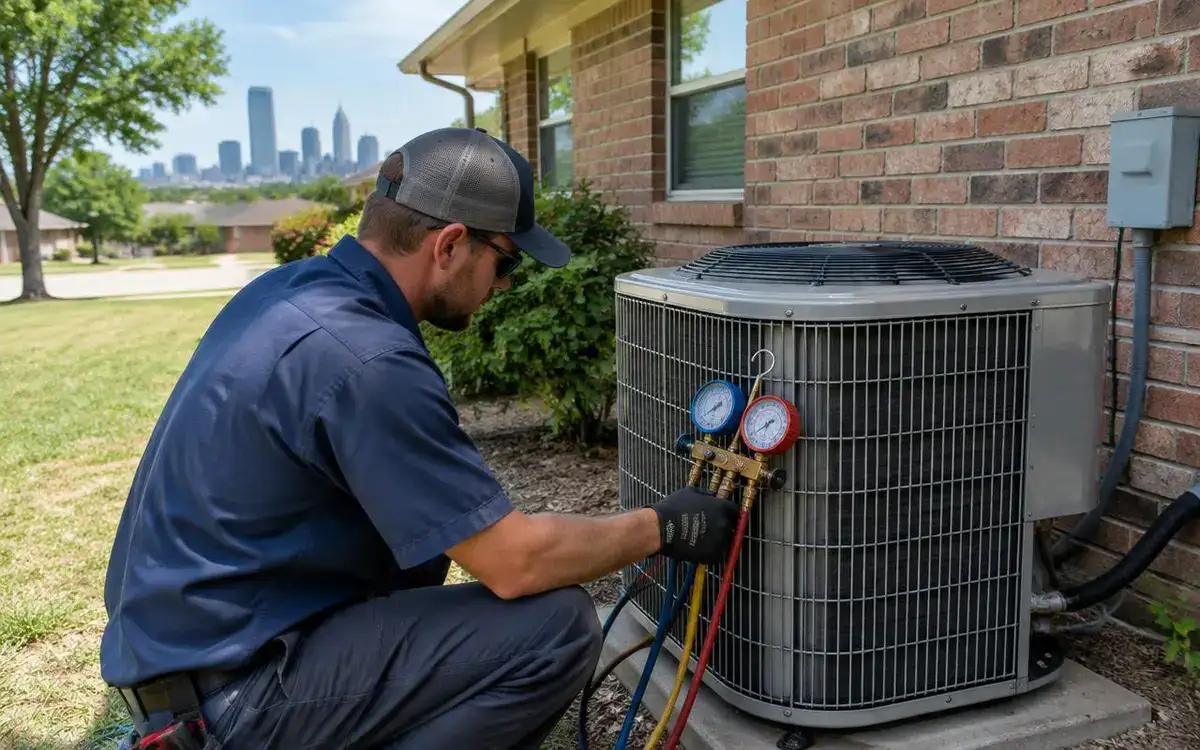
- Checks refrigerant pressure with gauges on the service ports and compares it to the manufacturer's target charge.
- Uses an electronic leak detector or UV dye to find a refrigerant leak if the charge is low.
- Tests the capacitor and contactor with a multimeter for correct values.
- Inspects the blower motor and wheel for dust buildup or a failing motor.
- Cleans the outdoor condenser coil with a coil cleaner and a hose if it is caked with debris.
- Checks duct connections at the air handler for leaks or disconnects that let cool air escape into the attic.
What a no-cold-air repair usually costs
| Job | Typical price |
|---|---|
| Diagnostic visit | $75 – $150 |
| Capacitor replacement | $150 – $350 |
| Refrigerant leak repair plus recharge | $300 – $1,500 |
| Coil cleaning | $100 – $250 |
| Blower motor replacement | $300 – $700 |
| Compressor replacement | $1,200 – $3,500 |
AC running but no cold air: warm air vs weak airflow
Warm air with strong airflow points to the outdoor unit: a failed capacitor, a stopped condenser fan, a tripped outdoor breaker, or low refrigerant. Cool air with weak airflow points indoors: a clogged filter, a frozen coil, closed vents, or a failing blower. Telling these apart narrows an AC not blowing cold air call before the technician arrives.
How to reset a central AC not blowing cold air
Some thermostats also have a 5-minute compressor delay after any change, so give it time. A repeated reset can hide a failing part, so treat an AC not blowing cold air after a reset as a repair call.
- With an AC not blowing cold air, set the thermostat to Off.
- Switch off the AC breaker at the main panel and the disconnect switch next to the outdoor unit.
- Wait 5 minutes so the compressor pressure can even out.
- Turn both back on, then set the thermostat to Cool, 3 to 5 degrees below room temperature.
- Wait 15 minutes. If the AC not blowing cold air problem returns, or the breaker trips again, stop resetting and call a technician.
Prevention
- Replace the filter every 1 to 3 months, more often with pets or during pollen season.
- Schedule an AC tune-up each spring before the first 90°F stretch to catch a weak capacitor or low charge early.
- Trim plants and grass back at least 2 feet from the outdoor condenser so air can flow through the coil.
- Keep interior vents open and unblocked by furniture or rugs; closed vents strain the blower and can lead to icing.
- Watch for ice on the coil or lines; shut the system to fan-only immediately if you see it rather than letting it run.
Why this happens more in this region
Tulsa summers push outdoor units through months of 95°F-plus days with high humidity, which runs the compressor far harder than mild-climate regions and shortens capacitor life. Many homes here also have attics that reach 130°F or more, which stresses ductwork seals and can cause slow leaks that cut cooling capacity over a season rather than all at once. Dust and pollen common across Midtown, Broken Arrow, and Owasso also clog filters faster during spring and fall.
Questions to ask before hiring an AC technician
Ask whether the quote is a flat rate or hourly, whether the diagnostic fee applies toward the repair if you proceed, and whether the technician is licensed through the Oklahoma Construction Industries Board. Ask if parts carry a separate manufacturer warranty beyond the labor warranty, and get the total price in writing before work starts, including any refrigerant cost per pound.
Seasonal timing for service calls
Spring and fall are the slowest seasons for HVAC companies, which usually means faster scheduling and more time for a thorough tune-up compared to the peak demand of a July heat wave. Booking a spring check before the first 90°F stretch can catch a weak capacitor or low refrigerant before it becomes a no-cool emergency.
Warranty and manufacturer considerations
Check the manufacturer's warranty before paying for a part replacement; many compressors, heat exchangers, and tanks carry a 5 to 10 year parts warranty even if labor is not covered. Keep the installation date and model number handy, since a technician needs both to confirm warranty coverage with the manufacturer.
A warranty claim does not cover labor in most cases, so budget for a service call and installation labor even on a part replaced for free under warranty.
Why homes with newer construction still have cooling problems
Newer homes in Bixby and Owasso built since the 2000s often have tighter ductwork but larger great rooms, which can leave an undersized or unbalanced system blowing cool air near the thermostat while back bedrooms stay warm. This is not usually a repair issue but a sizing or duct-balancing issue a technician can diagnose with a few vent readings.
Renters and older Tulsa homes
Homes in Brookside, Cherry Street, and Kendall-Whittier with window or older central units sometimes have undersized electrical circuits that trip a breaker under full summer load. If the breaker trips more than once, that points to an electrical issue, not a simple AC repair, and should be checked by a licensed electrician alongside the HVAC technician.
Next steps for Tulsa homeowners
Questions Tulsa homeowners ask
Why is my AC running but not cooling the house?
The most common reasons are a clogged filter, low refrigerant from a leak, or a frozen evaporator coil. Check and replace the filter first; it solves a large share of these calls.
Can I add refrigerant to my AC myself?
No. Refrigerant purchase and handling requires EPA Section 608 certification. A low charge also means there is a leak somewhere that needs to be found and fixed, not just topped off.
Why did ice form on my AC coil?
Ice points to restricted airflow, usually a dirty filter or blocked vents, or low refrigerant. Running the system longer with ice on the coil can damage the compressor.
How much does it cost to fix an AC that is not blowing cold?
Simple fixes like a filter or capacitor run $15 to $350. A refrigerant leak repair runs $300 to $1,500. A full compressor replacement runs $1,200 to $3,500.
How long can I run my AC on fan-only to thaw a frozen coil?
Plan for 2 to 4 hours with the system set to fan-only and cooling off. Do not restart cooling mode until the coil is fully thawed and dry.
Is a warm AC an emergency in summer?
It can be, especially with infants, older adults, or pets in the home during a 95°F-plus stretch. Most HVAC companies prioritize no-cool calls in peak summer.
Will a dirty outdoor unit stop my AC from cooling?
Yes. A condenser coil caked with grass clippings or leaves cannot release heat properly, which raises pressure in the system and cuts cooling capacity.
How often should I replace my AC filter in Tulsa?
Every 1 to 3 months is standard. During high pollen season in spring, or with pets shedding, check it monthly.