
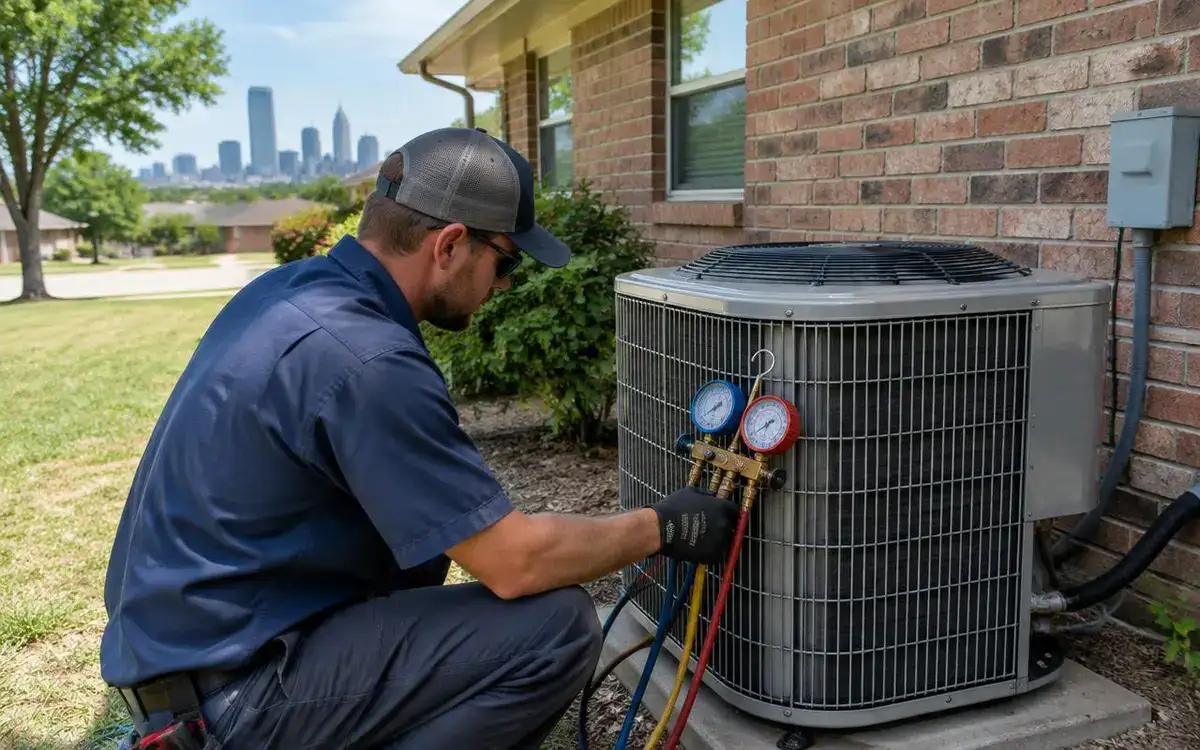
HVAC repair near me: what a Tulsa service visit covers
HVAC repair and air conditioner repair are one visit here: the same tech checks the outdoor condenser and the indoor air handler or furnace coil. The $75 to $150 diagnosis fee usually applies toward the repair if you approve it the same day.
- Air blows but is not cold, or only slightly cooler than the room.
- The outdoor unit hums but the fan does not spin.
- Ice builds up on the refrigerant line or indoor coil.
- Short cycling: the system turns on and off every few minutes.
- Water pooling near the indoor air handler or a clogged drain line.
- A burning smell or a breaker that trips when the AC starts.
What to tell the technician when you book AC repair
- The age and brand of the outdoor unit (printed on the data plate on its side).
- What the system does: no cooling, weak airflow, water leaking, ice on the lines, a breaker that trips, or a noise.
- When it started and whether a storm or power outage came first.
- Whether the thermostat screen is blank, which points to a power or low-voltage problem.
- Your ZIP code and the best time window, so the AC repair visit can be placed on the right route.
Common sounds and what they mean
A loud bang when the system starts often points to a hard-starting compressor, a sign the capacitor is weak and needs replacing before the compressor itself fails. A high-pitched squeal usually comes from a blower motor bearing or belt starting to wear, not the compressor.
A clicking sound that repeats every few seconds without the system starting is often a failed start relay or contactor, while a steady hiss near the indoor coil can mean a refrigerant leak at a fitting.
- Banging at startup: often a failing compressor or loose mounting hardware.
- Squealing: usually a blower motor bearing or belt issue.
- Clicking with no startup: a bad relay or contactor.
- Hissing near the coil: possible refrigerant leak.
Want a real price for your home?
Get a quoteWhy thermostats cause false no-cool calls
A surprising share of no-cool calls trace back to the thermostat, not the AC itself. Dead thermostat batteries, a setting accidentally switched to Heat or Fan Only, or a loose wire behind the thermostat plate can all look exactly like a dead compressor from a homeowner's point of view.
A smart thermostat that lost Wi-Fi connection sometimes reverts to a default schedule that does not match the home's usual settings, which can look like a sudden system failure when it is really a programming issue.
How humidity affects comfort beyond temperature
An AC that reaches the set temperature but still leaves a house feeling clammy is often short-cycling, running brief bursts that cool the air without running long enough to pull out humidity. Tulsa's summer humidity regularly sits above 60 percent, so a properly sized, properly running system needs longer run times to dehumidify, not just cool.
An oversized system is a common cause of this problem: it cools the air quickly, shuts off, and never runs long enough to remove moisture, leaving rooms feeling damp even at 72°F.
Second opinions on big repair estimates
For any single repair quoted above $1,000, especially a compressor or evaporator coil replacement, a second opinion from another licensed technician is reasonable and common. Bring the first technician's written diagnosis, including the measured refrigerant pressures or electrical readings, so the second tech can compare notes rather than starting from scratch.
A second opinion costs another diagnostic fee, typically $75 to $150, but can save far more if the first estimate was for a full system replacement when a single part would have solved the problem.
Typical AC repair costs in Tulsa
These are typical ranges for Tulsa AC repair and air conditioning service calls. A written price from the technician before work starts is the number that matters.
| Repair | Typical price |
|---|---|
| Diagnostic / service call | $75 – $150 |
| Capacitor replacement | $150 – $350 |
| Contactor replacement | $150 – $300 |
| Refrigerant leak repair + recharge | $300 – $1,200 |
| Condenser fan motor | $350 – $700 |
| Blower motor replacement | $400 – $900 |
| Evaporator coil replacement | $1,200 – $2,800 |
Insurance and home warranty claims
Standard homeowners insurance generally does not cover AC failure from normal wear, since that falls under maintenance, not a covered peril like fire or storm damage. A home warranty plan, purchased separately, may cover compressor or electrical failures depending on the plan's terms and any required maintenance documentation.
If a storm or lightning strike damages a unit's electrical components, that is more likely to be a homeowners insurance claim; ask your technician to note any evidence of an electrical surge in their diagnosis for the claims adjuster.
Why Tulsa AC units fail in summer
Tulsa summers run 95°F and higher with heavy humidity, and the outdoor unit works for months without a break. Dust and cottonwood fluff clog the condenser fins, which raises head pressure and strains the compressor. Homes with attic ductwork see extra strain because attic temperatures can top 130°F, which pushes the air handler and ducts harder.
A dirty air filter is the single most common cause of a frozen coil in Tulsa. Replace a standard filter every 1 to 3 months during peak cooling season.
AC repair on older units: the refrigerant question
Many Tulsa AC units installed before 2010 run on R-22 refrigerant, which has not been made in the US since 2020. AC repair on these units is still possible, but recharging R-22 now costs $90 to $175 per pound, and a typical leak repair needs 2 to 4 pounds.
Units installed from 2010 to 2024 use R-410A. New systems installed from 2025 use R-454B or R-32. A technician doing AC repair in Tulsa should tell you which refrigerant your unit uses before quoting a recharge, and should find and fix the leak instead of only adding refrigerant.
Older homes and electrical capacity
Homes in Kendall-Whittier, Florence Park, and other older Tulsa neighborhoods sometimes still run on electrical panels installed decades before central air became standard. A modern AC's startup draw can trip an undersized breaker or reveal worn wiring, which shows up as repeated breaker trips that look like an AC problem but are really an electrical capacity issue.
A technician who finds repeated breaker trips not explained by a capacitor or contactor failure should check the breaker amperage rating and wire gauge against the unit's electrical requirements before assuming the AC itself is at fault.
AC repair vs replacement
An air conditioner under 10 years old with a single part failure is usually worth repairing. A unit over 12 to 15 years old, especially one using R-22 refrigerant, often costs more to keep patching than to replace. R-22 was phased out and now costs far more per pound than modern R-410A refrigerant.
As a rule of thumb, if a repair quote is more than half the cost of a new unit and the system is past 12 years old, ask for a replacement quote too.
What happens on an AC repair visit
- The HVAC technician checks refrigerant pressure, electrical components, the thermostat and airflow.
- You get a written diagnosis and price before any repair starts.
- Common parts like capacitors and contactors are often on the truck.
- The tech tests the system under a full cooling cycle before leaving.
- You get notes on what to watch so the same failure does not repeat.
Emergency AC repair in Tulsa or next available visit?
If your home is above 85°F inside, a pet or an older adult is home, or the system is tripping a breaker, choose a same-day or emergency slot. If the air is simply a few degrees warm and the system still runs, a next-day appointment usually works fine.
Tulsa AC repair service area
HVAC techs in this network cover Tulsa ZIP codes 74101 through 74146, Broken Arrow (74011, 74012, 74014), Owasso, Bixby, Jenks and Sand Springs.
DIY checks before you call
- Check the thermostat is set to Cool and the temperature is below room temperature.
- Look in the main panel for a tripped breaker labeled AC or condenser.
- Replace the air filter if it looks gray or clogged.
- Check the outdoor disconnect switch near the condenser is pushed in.
- Look for ice on the indoor coil or lines; if present, switch to fan-only to thaw before the tech arrives.
Understanding your AC's main parts
The outdoor condenser unit holds the compressor, which is the most expensive part in the system, along with the condenser coil and fan. The compressor squeezes refrigerant into a hot, high-pressure gas, then the outdoor fan blows air across the coil to release that heat outside.
Indoors, the evaporator coil sits above or next to the furnace or air handler. Refrigerant expands and cools there, and the blower fan pushes air across the cold coil and through the ducts into each room. A problem with any single part, the compressor, either fan, either coil, or the refrigerant charge itself, can stop the whole system from cooling.
The thermostat and a set of electrical components, including the capacitor and contactor, control when the system runs. These electrical parts fail more often than the compressor because they take the stress of starting the system every cycle.
How long does an AC repair visit take?
A simple capacitor or contactor swap usually takes 30 to 60 minutes once the technician diagnoses the problem. A refrigerant leak repair can take 2 to 4 hours, since the tech needs to find the leak, repair it, pull a vacuum on the line set, and recharge the system with the correct refrigerant amount.
A full coil replacement is the longest common repair, often a half day, because the old coil has to come out of the air handler cabinet and the new one has to be fitted, brazed in, and tested for leaks before the system runs again.
- Capacitor or contactor: 30 – 60 minutes.
- Refrigerant leak find and recharge: 2 – 4 hours.
- Condenser fan motor: 1 – 2 hours.
- Evaporator coil replacement: 4 – 8 hours.
Before you book: Tulsa price and problem guides
- Read the AC repair cost guide.
- Read the AC not blowing cold air guide.
Questions Tulsa homeowners ask
How much does ac repair cost in Tulsa?
Most Tulsa ac repair jobs run $150 to $600 after a $75 to $150 diagnostic fee. A capacitor is the cheapest common fix; a coil replacement is the most expensive.
Why is my hvac repair tulsa unit blowing warm air?
The most common causes are a dirty filter, a failed capacitor, low refrigerant from a leak, or a frozen evaporator coil that needs time to thaw.
Can an ac repair tulsa tech come same day?
Many techs offer same-day visits, especially for no-cool calls in summer. Choose Today in the quote form.
Is tulsa ac repair covered by a home warranty?
Some home warranty plans cover HVAC repairs. Check your plan's coverage and call the warranty company before scheduling an independent tech if you want warranty coverage.
How often should I service my AC to avoid repairs?
A yearly tune-up before summer catches worn capacitors, low refrigerant and dirty coils before they cause a breakdown.
What refrigerant does my Tulsa AC use?
Units installed before about 2010 often use R-22, which is expensive and being phased out. Units after that mostly use R-410A.