
Warning signs of a broken sewer line
- More than one drain is slow or backs up at the same time.
- Gurgling in a toilet when the washer drains or a tub empties.
- Sewage or dirty water coming up in a floor drain, shower or tub.
- Sewer smell inside the house or in the yard.
- A soggy, sunken or extra-green strip of grass between the house and the street.
- Roots cleared from the line more than once in 2 years.
Reading a sewer camera report
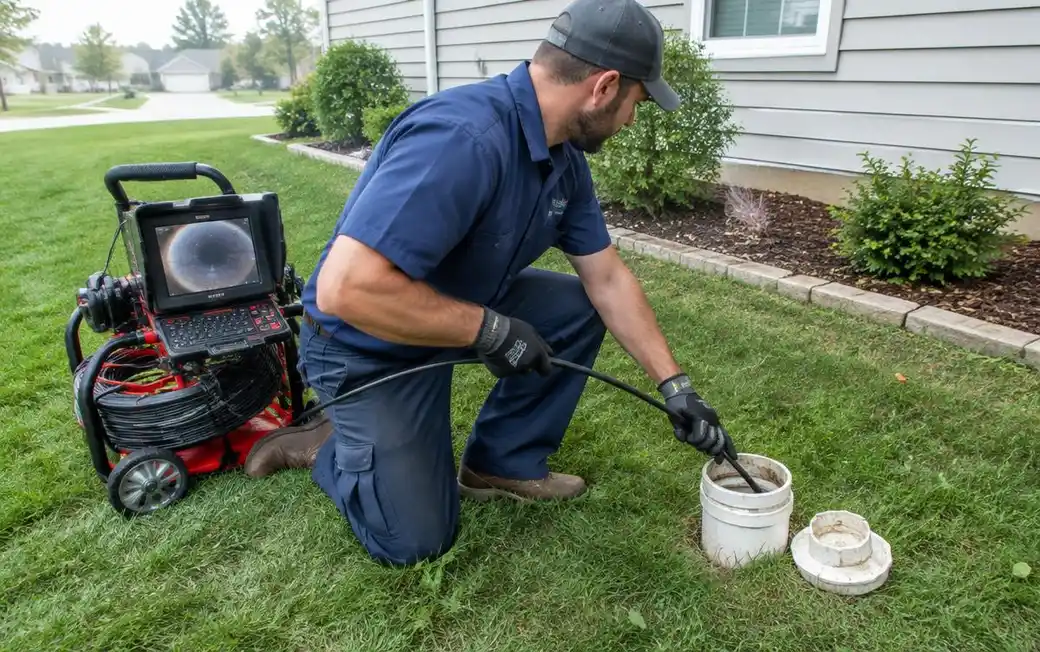
A camera inspection gives you a video and often a written report with footage marks. The footage number tells you how far the problem is from the cleanout, which tells the plumber where to dig. Ask the plumber to walk you through these terms:
- Root intrusion: roots growing through a joint. Light roots can be cut; heavy roots return within a year.
- Offset joint: one pipe section has shifted up or down from the next, catching paper and waste.
- Belly or sag: a low section that holds standing water. The camera lens goes underwater.
- Crack or fracture: a split along the pipe wall.
- Collapse: the pipe has caved in. The camera cannot pass.
- Scale: rough buildup inside cast iron pipe that narrows the flow.
Sewer cleanouts
A cleanout is a capped pipe, usually 3 or 4 inches wide, where a plumber can reach the sewer line without pulling a toilet. In Tulsa homes it is often outside near the foundation or in the yard between the house and the street. Older Midtown homes may have no outside cleanout at all.
If your home has no cleanout, the plumber may add one during the repair for $300 to $800. It makes every future camera inspection and clog call faster and cheaper.
Want a real price for your home?
Get a quoteHow to slow down sewer line problems
- Do not plant trees or large shrubs over the sewer line route.
- Keep grease, wipes (even ones labeled flushable) and paper towels out of drains.
- Ask for a camera inspection before you buy an older Tulsa home. It costs $150 to $400 and can save thousands.
- If roots are a known problem, schedule cleaning every 12 to 18 months until the line is replaced.
Sewer line age and material by Tulsa era
Knowing your home's build era gives a rough idea of what the camera will likely find, though past repairs and remodels can mix materials in one line.
| Build era | Common pipe material | Typical issue |
|---|---|---|
| Before 1950 | Clay tile | Root intrusion, offset joints |
| 1950s – 1960s | Cast iron or Orangeburg | Scale buildup, collapse |
| 1970s – 1980s | Clay or early PVC | Mixed; depends on remodel history |
| 1990s – present | PVC | Fewer joints, longer life |
Homeowners insurance and sewer lines
Standard homeowners policies in Oklahoma usually exclude sewer line failure from age, roots or wear, since insurers treat that as a maintenance issue rather than sudden damage. Some insurers sell a separate service line endorsement for $20 to $50 a year that covers sewer and water line failures up to a set limit.
Check your declarations page or call your agent before a repair to see if you already carry this coverage, since it can offset a $1,500 to $15,000 repair bill.
Trenchless lining vs pipe bursting
Cured-in-place pipe (CIPP) lining pulls a resin-soaked felt tube through the old sewer line, then cures it with hot water or UV light into a new pipe-within-a-pipe. It works when the old pipe still holds its round shape, and it shaves 1 to 2 inches off the inside diameter.
Pipe bursting pulls a steel bursting head through the old pipe, cracking it outward while a new HDPE pipe is pulled in behind it at the same time. Bursting works on collapsed or badly offset pipe that lining cannot bridge, and it keeps the full original diameter or slightly larger.
- CIPP lining: best for root intrusion and hairline cracks, 1 to 2 day job.
- Pipe bursting: best for collapsed sections or bellied pipe, needs two small access pits.
- Both methods avoid trenching the full yard, driveway or sidewalk.
- Neither method works through a sharp offset greater than about 1.5 inches.
Why tree roots target sewer lines in Tulsa yards
Clay and cast iron sewer joints, common in homes built before the 1980s, leak a small amount of water vapor that draws roots from maple, oak and elm trees planted near the house. Roots enter at the joint as fine hairs, then thicken over several years until they choke the pipe.
A root-clogged line often backs up first in the lowest drain in the house, usually a basement floor drain or a downstairs shower. Mechanical root cutting opens the line fast but the roots grow back in 6 to 18 months unless the joint itself gets lined or replaced.
City of Tulsa sewer tap and right-of-way rules
- The sewer line from the house to the City main crosses the yard, the sidewalk and sometimes the street right-of-way.
- Work in the street right-of-way may need a separate City of Tulsa right-of-way permit in addition to the plumbing permit.
- Okie811 locates must be called at least two full business days before any digging, including pipe bursting pits.
- A damaged section under a City sidewalk is usually repaired by the contractor, then the concrete square is replaced to match.
Sewer line repair cost in Tulsa
Depth, length, a driveway or tree over the line and whether a cleanout exists all change the price. Ask for the camera video so you can see the damage yourself.
| Job | Typical range |
|---|---|
| Camera inspection | $150 – $400 |
| Root cutting (cable) | $250 – $600 |
| Hydro-jetting the main line | $400 – $900 |
| Spot repair (one dig, one section) | $1,500 – $4,500 |
| Trenchless lining (per foot) | $80 – $250 |
| Full replacement, open trench | $5,000 – $15,000 |
After the repair: restoring your yard
- Open trench repairs leave a dirt trench that settles over several weeks; ask if topsoil and seed are included.
- Trenchless methods leave only one or two small access pits, which are easier to restore.
- Sprinkler lines crossing the dig path may need reconnecting; point them out before work starts.
- Ask for a final camera pass so you have a record of the repaired line's condition.
Living through a sewer line repair
A spot repair usually limits water use for a day; a full replacement can mean no water use in the home for the better part of a day while the line is disconnected and reconnected. Ask the plumber for a realistic timeline before scheduling, especially if you have small children, elderly residents, or pets at home, so you can plan around the outage.
If the repair opens a section of driveway or a walkway, ask how long before the area is safe to drive or walk on; fresh concrete patches often need several days to cure before they bear weight.
City of Tulsa service line warranty and sewer line repair
The City of Tulsa offers homeowners an optional service line warranty plan through an outside provider. It is a monthly fee added to the city utility bill, and it can cover repair of the private sewer lateral between your house and the city main. Terms, monthly cost and coverage limits are listed on the City of Tulsa utilities website.
If you already pay for the plan, call the warranty provider before booking a sewer line repair yourself. Work done by your own plumber is usually not reimbursed. If you do not have the plan, a sewer line repair in Tulsa is paid by the homeowner, because the lateral from the house to the city tap belongs to the property.
Sewer line cleaning vs sewer line repair
A slow drain from roots or grease often needs cleaning, not repair. Cable cleaning (snaking) costs $175 to $400 in Tulsa and cuts roots for 6 to 18 months. Hydro jetting costs $400 to $900 and removes roots, grease and scale from the pipe wall.
Sewer line repair is needed when the camera shows a crack, a collapsed or offset joint, a belly that holds water, or roots coming back through the same joint within a year. Ask the plumber for the camera video and the footage marks of each defect before you pay for either job.
What causes sewer line damage in Tulsa
Many Tulsa homes built before the 1970s, including much of Midtown, Maple Ridge and Brookside, have clay tile sewer pipe with joints every 2 to 3 feet. Tree roots from oaks, maples and elms grow into those joints. Homes from the 1950s and 1960s may also have cast iron or Orangeburg (tar paper) pipe, which cracks and collapses.
Tulsa's clay soil swells after heavy rain and shrinks during dry heat. That shifting creates bellies (low spots where waste sits) and offset joints.
Sewer repair methods
- Spot repair: the plumber digs at the damaged spot and replaces 3 to 10 feet of pipe with PVC.
- Trenchless lining (CIPP): a resin liner is pulled through the old pipe and cured in place. Little digging, but the old pipe must still hold its shape.
- Pipe bursting: a new HDPE pipe is pulled through while the old pipe is broken outward. Needs two access pits.
- Open trench replacement: the whole line is dug up and replaced. Often the right choice for a collapsed or badly bellied line.
Choosing between repair methods: what to ask
- Ask to see the camera footage yourself, not just hear a description.
- Ask why this method was chosen over the others for your specific damage.
- Ask for the warranty length on the repaired section.
- Ask whether Okie811 locates have been called before any digging starts.
- Get the total price in writing, including any concrete, driveway or landscaping restoration.
How the repair works
- The plumber runs a camera through a cleanout or a pulled toilet and records the video.
- A locator marks the depth and the spot of the problem in your yard.
- You get a written price for the repair method that fits the damage.
- Before digging, Okie811 is called to mark gas, power and cable lines. This is free and required by law.
- The plumber pulls the permit, makes the repair and runs the camera again to show the fixed line.
Who owns the sewer line?
In Tulsa, the homeowner usually owns the service line from the house to the connection with the city main, often near the street or alley. The City of Tulsa owns the main. If the camera shows the problem is in the main, call the City of Tulsa customer care line at 311.
Repair or replace your sewer line
Repair one section when the camera shows a single crack, offset joint or root spot and the rest of the pipe is sound. Replace or line the whole run when roots show up in many joints, the pipe is Orangeburg, or the line has a belly longer than a few feet.
A full replacement costs more today, but it ends repeat cleaning bills that often add up to $300 to $600 a year.
Sewer line repair service area
Plumbers in this network serve Tulsa, Broken Arrow, Owasso, Bixby, Jenks and Sand Springs. If sewage is coming into the house now, stop using water, do not run the washer or dishwasher, and choose Today in the form.
Before you book: Tulsa price and problem guides
- Read the sewer line replacement cost guide.
- Read the sewer line warning signs.
Next steps for Tulsa homeowners
- See drain cleaning.
- See hydro-jetting.
- See clogged drain.
Questions Tulsa homeowners ask
How much does a sewer camera inspection cost in Tulsa?
Most Tulsa plumbers charge $150 to $400. Some apply it to the repair price if you hire them.
Does homeowners insurance cover sewer line repair?
Most standard policies do not cover wear, roots or age. Some insurers sell a service line add-on. Check your policy.
How long does sewer line repair take?
A spot repair takes 1 day. Trenchless lining takes 1 to 2 days. Full open trench replacement takes 2 to 4 days.
Can roots be removed for good?
Cutting or jetting clears roots for 1 to 2 years. Only replacing or lining the pipe stops them from coming back.
Is trenchless cheaper than digging?
Per foot it often costs about the same, but it saves the cost of repairing a driveway, lawn or landscaping.
Do I need a permit for sewer repair in Tulsa?
Yes. Sewer repair and replacement need a City of Tulsa permit, which a licensed plumber pulls.