
Tank vs tankless water heater: the short answer
Choose a tank water heater if you want the lowest upfront cost, a straightforward swap, and your household rarely runs multiple hot water fixtures at once. Choose tankless if you run out of hot water often, want to save space, plan to stay in the home 10+ years, and can afford the higher install cost.
Both types supply hot water reliably when sized correctly. The decision mostly comes down to upfront budget versus long-term operating cost and convenience.
How each type works
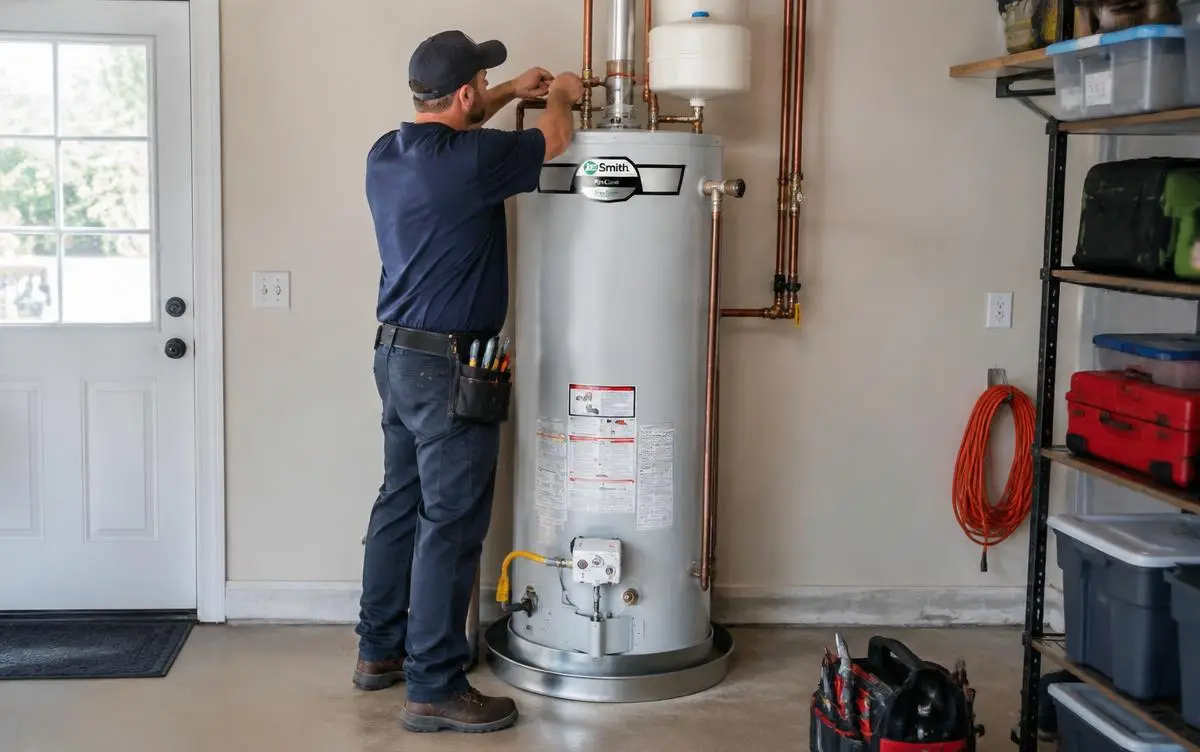
A tank water heater stores 30 to 80 gallons of hot water, keeping it heated and ready around the clock. When you run a tap, hot water flows from the top of the tank while cold water refills the bottom, and the tank reheats continuously to maintain temperature.
A tankless water heater has no storage tank. Cold water passes through a heat exchanger that fires on demand, heating water as it flows, so it only uses energy when a tap is actually open. This is why it is also called an on-demand or instant water heater.
Side-by-side comparison
| Factor | Tank water heater | Tankless water heater |
|---|---|---|
| Typical installed cost | $800 – $1,800 | $2,500 – $4,500 |
| Lifespan | 8 – 12 years | 15 – 20 years |
| Hot water supply | Limited to tank size, then a wait to reheat | Continuous, as long as demand is within flow rate |
| Energy use | Heats water 24/7, standby loss even when idle | Heats only when a tap is open, 8-34% more efficient |
| Space needed | Closet or utility space for a 30-80 gallon tank | Compact wall-mounted unit, frees up floor space |
| Install complexity | Simple swap in most homes, 2-4 hours | Often needs new gas line, venting, or electrical, 4-8 hours |
| Multiple showers at once | Can run out if demand exceeds tank size | Handles multiple fixtures if sized for the flow rate |
| Maintenance | Flush sediment yearly, replace anode rod | Descale yearly in hard water areas, less sediment buildup |
Want a real price for your home?
Get a quoteUpfront cost breakdown
| Item | Tank | Tankless |
|---|---|---|
| Unit cost | $400 – $900 | $1,000 – $2,200 |
| Installation labor | $300 – $600 | $800 – $1,800 |
| Gas line or venting upgrade | Rarely needed | $300 – $1,200 if upgrade required |
| Electrical upgrade (electric tankless) | N/A | $500 – $1,500 if panel upgrade needed |
| Total typical range | $800 – $1,800 | $2,500 – $4,500 |
Long-term operating cost
A tank water heater loses heat to the surrounding air around the clock, called standby loss, which adds to monthly utility bills even when no one uses hot water. A gas tank unit typically costs $300 to $500 a year to run for a family of four.
A tankless unit avoids standby loss entirely and typically runs 8% to 34% more efficient depending on household hot water use, which can save $70 to $150 a year. Over a 15-year tankless lifespan versus roughly two tank replacements in the same period, total cost of ownership often favors tankless for households that keep the home long-term.
Which households fit each type
- Tank fits well: 1-3 person households, lower upfront budget, homes planning to sell within 5 years, or homes where gas line or venting upgrades would be expensive.
- Tank fits well: households that rarely run two hot water fixtures (shower plus dishwasher plus laundry) at the same time.
- Tankless fits well: 4+ person households that regularly run out of hot water with a tank unit.
- Tankless fits well: households planning to stay 10+ years, where the higher upfront cost pays off in lifespan and efficiency.
- Tankless fits well: homes with limited utility closet space, since a tankless unit mounts on a wall and frees floor space.
- Tankless fits well: households wanting to pair with multiple bathrooms or a soaking tub that demands high, continuous flow.
Sizing a tank water heater
| Household size | Recommended tank size |
|---|---|
| 1-2 people | 30 – 40 gallons |
| 2-3 people | 40 – 50 gallons |
| 3-5 people | 50 – 65 gallons |
| 5+ people | 65 – 80 gallons |
Tank vs tankless water heater: lifespan and payback
In the tank vs tankless water heater choice, the longer life of a tankless unit is a bigger part of the payback than the monthly gas savings. If you plan to sell within five years, the tank vs tankless water heater answer is usually a tank.
| Factor | Tank | Tankless |
|---|---|---|
| Typical lifespan | 8 to 12 years | 15 to 20 years with yearly descaling |
| Hot water supply | Runs out when the tank empties | Continuous, limited by flow rate (gallons per minute) |
| Works in a power outage (gas) | Yes, most standing-pilot models | No; needs electricity for the fan and controls |
| Payback of extra cost | None needed | Often 10+ years from gas savings alone |
Tank vs tankless water heater complaints homeowners report
Most of these complaints come from sizing. Before you settle tank vs tankless water heater, ask the installer for the flow rate (GPM) at your winter incoming water temperature.
- Tankless: a short burst of cold water between two hot uses (the cold water sandwich).
- Tankless: a longer wait for hot water at far faucets unless a recirculation pump is added.
- Tankless: not enough flow for two showers and a washer at once on an undersized unit.
- Tank: running out of hot water with a large tub or a big household.
- Tank (the cheaper side of tank vs tankless water heater): rumbling and shorter life from sediment if the tank is never flushed.
Sizing a tankless water heater
Tankless units are sized by flow rate in gallons per minute (GPM), not storage volume. A single shower uses roughly 2 to 2.5 GPM, a dishwasher about 1.5 GPM, and a washing machine about 2 GPM. Add up the fixtures you expect to run at once and size the unit to exceed that total GPM, factoring in your area's incoming groundwater temperature, which runs colder in winter and requires more heating capacity.
Most single-family homes in this area need a unit rated for 7 to 10 GPM to run two showers and a dishwasher at once without a drop in temperature.
Installation considerations in this area
Switching from tank to tankless often requires upgrading the gas line, since tankless units need a higher BTU input than most tank units. It may also require adding or upgrading venting, since tankless units typically vent through PVC rather than the metal flue a tank uses.
Groundwater entering homes here runs cooler in winter than in warmer climates, which means a tankless unit works harder to hit target temperature during the coldest months. Ask your plumber to size the unit for winter incoming water temperature, not just summer, to avoid a unit that falls short on cold mornings.
Maintenance differences
- Tank: flush sediment from the bottom of the tank once a year to prevent efficiency loss and rumbling noises, and check the anode rod every 2-3 years, replacing it when more than 50% corroded.
- Tank: a sacrificial anode rod prevents tank corrosion; once it is fully consumed, the tank itself starts rusting from the inside.
- Tankless: descale the heat exchanger once a year with a vinegar or descaling solution flush, especially important with harder water, to prevent mineral buildup that reduces flow and efficiency.
- Tankless: clean the inlet water filter screen periodically to maintain full flow rate.
- Both: have a plumber inspect connections, venting, and the pressure relief valve yearly regardless of type.
Common mistakes when switching
- Undersizing a tankless unit for the home's actual peak demand, leading to lukewarm water when two fixtures run at once.
- Skipping the gas line upsizing, which can starve a tankless unit of the fuel it needs to hit full output.
- Ignoring winter groundwater temperature when sizing, since a unit sized for summer may fall short in January.
- Installing tankless in hard water without a water softener or descaling plan, which shortens heat exchanger life.
- Assuming tankless is always cheaper long-term; for a 1-2 person household with low hot water use, a tank may never make up the cost gap.
Rebates and incentives
High-efficiency tankless water heaters sometimes qualify for utility rebates or federal tax credits under current energy efficiency programs. Check with your contractor and ONG for any available rebate before purchase, since programs and amounts change.
Making the final decision
Walk through three questions: How long do you plan to stay in the home? How often does your household run out of hot water now? Can your budget absorb the higher tankless install cost today in exchange for lower bills and a longer lifespan later? A plumber can also do a quick gas line and venting assessment to tell you exactly what a tankless conversion would cost in your specific home before you decide.
Get a written quote for both options before deciding, even if you are leaning one way. A side-by-side quote shows exactly how much more a tankless install costs in your specific home once gas line, venting, and labor are factored in, which can be a smaller gap than the general price ranges above suggest, or a larger one if your gas line needs a full upsize.
Hybrid option: a larger tank for less of the downside
A larger tank size, such as moving from 40 to 50 gallons, can solve a household's hot water shortage for a fraction of a tankless unit's extra cost. This does not fix standby heat loss or extend lifespan, but it is worth asking about if your main issue is simply running out of hot water during back-to-back showers rather than wanting the full tankless upgrade.
In Oklahoma, incoming water is cold enough in January to cut a tankless unit's flow rate, so size it for winter, not summer. For safety, any gas unit needs correct venting and a carbon monoxide alarm nearby. Tank heaters usually carry a 6 to 12 year warranty; tankless heat exchangers often carry 10 to 15 years.
Next steps for Tulsa homeowners
- Ready to fix it? get quotes for both types — a licensed local pro calls back with a price.
- See water heater repair.
- See water heater replacement cost.
Questions Tulsa homeowners ask
Is tankless really worth the extra cost?
For households that stay 10+ years and run multiple hot water fixtures, yes. For 1-2 person households with low demand or a short-term home, a tank often makes more financial sense.
Can I install a tankless unit in the exact same spot as my tank?
Often not directly. Tankless units usually mount on a wall and need different venting than a tank's flue, so placement commonly changes during a switch.
Do tankless water heaters really provide unlimited hot water?
Yes, as long as the demand stays within the unit's rated flow rate. Exceed that flow rate, such as running three showers at once on an undersized unit, and output drops.
How long does a tank water heater actually last?
Most tank units last 8 to 12 years. Replacing the anode rod on schedule can extend life toward the higher end of that range.
Do tankless water heaters need more maintenance?
They need an annual descaling flush, especially in hard water, but otherwise need less maintenance than a tank since there is no sediment buildup inside a storage tank.
Will switching to tankless lower my gas bill?
Usually yes, since tankless units avoid standby heat loss. Savings of $70 to $150 a year are typical, though actual savings depend on household hot water use.
What size tankless unit do I need for a family of four?
Most four-person households need a unit rated 7 to 9 GPM to handle two showers and a dishwasher or washing machine running together.