
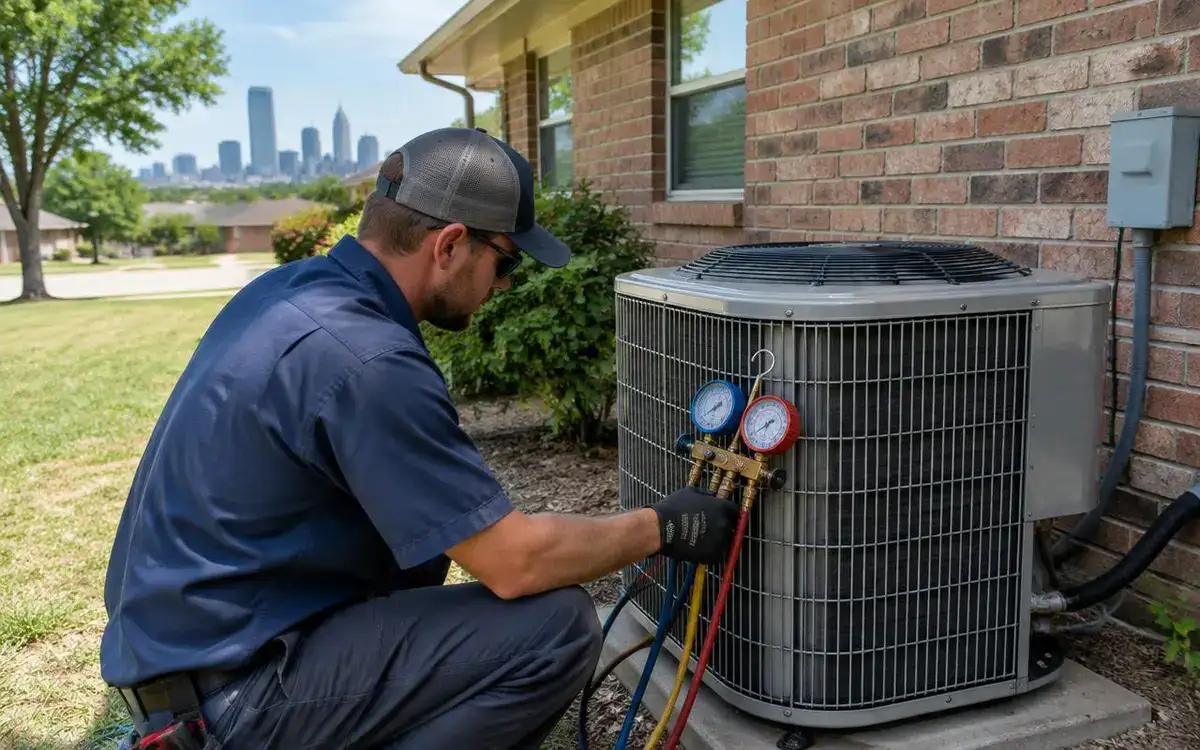
Heating and air services in Tulsa
- AC installation: new central AC or heat pump systems sized with a Manual J load calculation.
- Furnace repair: igniters, flame sensors, blower motors, control boards and gas valves.
- AC repair in Owasso: capacitor, contactor, refrigerant leaks and frozen coils.
- Tune-ups: coil cleaning, refrigerant check, drain line flush and electrical test.
Types of heating and cooling systems in Tulsa
- Split AC with gas furnace: the most common setup. Outdoor condenser, indoor coil on top of a gas furnace.
- Heat pump with electric air handler: heats and cools with one outdoor unit; uses backup heat strips on the coldest nights.
- Dual fuel: heat pump plus gas furnace. The system switches to gas below a set outdoor temperature, often 30 to 35°F.
- Ductless mini-split: for additions, garages or older homes with no ducts.
- Packaged unit: all parts in one outdoor cabinet, often on slab homes with no attic space.
Ductwork and attic heat
Most Tulsa ranch homes run ductwork through the attic. On a July afternoon, attic air can pass 130°F. Leaky or poorly insulated ducts there can waste a large share of the cooled air before it reaches the rooms.
Signs of duct problems: rooms far from the unit are always warmer, dust builds up fast, and some vents blow weakly. A duct leakage test costs about $150 to $400. Sealing ducts with mastic and adding insulation often costs $1,000 to $3,000.
Want a real price for your home?
Get a quoteManual J load calculations
A Manual J calculation sizes a new AC or furnace to a home's actual square footage, insulation, window count and orientation, not just a rule of thumb like 1 ton per 500 square feet. An oversized unit cools fast but short-cycles, leaving the house cold and clammy. An undersized unit runs constantly on 95°F days and never quite catches up.
Ask any installer quoting a new system whether they ran a load calculation or are matching the size of your old unit. Matching old equipment can repeat a past sizing mistake.
Indoor air quality add-ons
- Media filters: thicker than a standard 1-inch filter, changed every 6 to 12 months, $200 to $500 installed.
- UV lights: installed near the coil to reduce mold growth, $300 to $600.
- Whole-home dehumidifiers: useful in Tulsa's humid summers, $1,500 to $2,800 installed.
- Duct sealing: reduces dust and improves airflow, $1,000 to $3,000 depending on duct length.
Seasonal maintenance plans
Many Tulsa HVAC companies sell a twice-a-year maintenance plan covering a spring AC check and a fall furnace check, often $150 to $300 a year. Regular maintenance catches a weak capacitor or cracked heat exchanger before it fails on the hottest or coldest day of the year, and some manufacturer warranties require documented annual maintenance to stay valid.
How SEER2 ratings changed in 2023
The Department of Energy updated minimum efficiency testing in 2023 to SEER2, which uses a tougher duct-static-pressure test that better matches real installed conditions. A unit rated 14 SEER under the old test typically rates close to 13.4 SEER2 under the new one, so the numbers on a new unit's sticker are not directly comparable to an older unit's sticker.
The federal minimum for the southern region, which includes Oklahoma, is 14.3 SEER2 for split-system air conditioners. Ask an installer to quote both the SEER2 number and the old-style SEER equivalent so you can compare against your current system's rating plate.
Air handler vs furnace: what is in your attic or closet
- A furnace burns gas or runs electric heat strips and also houses the blower that moves air for the AC side.
- An air handler is the indoor coil and blower paired with an outdoor heat pump, used instead of a furnace in all-electric homes.
- Attic air handlers in Tulsa need a secondary drain pan with its own drain line as a backup if the primary condensate line clogs.
- Closet-mounted furnaces need a sealed combustion air source if the closet is inside conditioned living space.
Heating and air service by season in Tulsa
Booking heating and air maintenance before each peak season costs less than an emergency call and gets you a shorter wait.
| Season | Most common calls | Best time to book |
|---|---|---|
| Spring (March to May) | AC tune-ups, refrigerant checks, drain line clogs | March, before the first 90°F week |
| Summer (June to September) | Capacitors, fan motors, frozen coils, no-cool calls | Mornings, since afternoon wait times grow on hot days |
| Fall (September to November) | Furnace tune-ups, carbon monoxide checks | October, before the first freeze |
| Winter (December to February) | No-heat calls, igniters, heat pump defrost problems | Same day for no heat; next day for weak heat |
What to ask any heating and air company before booking
- The heating and air diagnostic or trip fee, and whether it is credited toward the repair.
- Flat-rate price or hourly, in writing, before work starts.
- Whether the technician holds an Oklahoma mechanical license (issued by the Construction Industries Board).
- The parts and labor warranty, and whether a maintenance plan is required to keep it.
- For a new heating and air system: a load calculation (Manual J) instead of sizing by square footage alone.
Heating and air or HVAC: same service
Heating and air, HVAC (heating, ventilation and air conditioning) and "heat and air" all mean the same trade in Oklahoma. One licensed company works on your AC, furnace, heat pump, ductwork and thermostat. If you are searching for HVAC in Tulsa, the services and prices on this page apply.
Typical HVAC prices in Tulsa
| Job | Typical range |
|---|---|
| Diagnostic visit | $80 – $150 |
| Capacitor replacement | $150 – $400 |
| Furnace igniter or flame sensor | $150 – $450 |
| Blower motor | $450 – $1,200 |
| Refrigerant leak repair and recharge | $400 – $1,500 |
| New AC system (condenser + coil) | $5,500 – $10,000 |
| New furnace | $3,500 – $7,000 |
How to vet an HVAC company in Tulsa
- Confirm the technician's Oklahoma HVAC/mechanical license, checkable through the Construction Industries Board.
- Ask if they are EPA 608 certified to handle refrigerant, which is required by federal law.
- Get a written estimate before a repair or installation, including parts and labor separately.
- Ask what the labor warranty covers and for how long.
- Ask for references or to see a Manual J load calculation on any new system quote.
Single-family vs zoned HVAC systems
- One system, one thermostat: lowest cost, whole house heats or cools together.
- Zoned system: dampers in the ductwork let upstairs and downstairs run at different temperatures from two thermostats.
- Zoning helps two-story Tulsa homes where the upstairs runs hotter in summer from attic heat.
- Mini-split systems add a dedicated zone to a bonus room or garage without new ductwork.
What an HVAC maintenance visit actually checks
A real tune-up takes 45 minutes to over an hour, not 10 minutes. The technician checks refrigerant charge against manufacturer specs, measures temperature split across the coil, tightens electrical connections, checks capacitor readings against their rating, and clears the condensate drain line.
A rushed visit that only wipes the outdoor unit and leaves is not a full tune-up. Ask for a written checklist with the readings taken, not just a sticker on the unit.
Electrical requirements that affect HVAC installs
Most residential AC condensers need a dedicated 208/240-volt circuit sized to the unit's rated amperage, typically a 20 to 40 amp breaker depending on the unit's tonnage. Furnaces usually run on a standard 120-volt 15-amp circuit for the blower motor and control board.
Homes built before the 1980s sometimes have a panel too small or too full to add a new HVAC circuit without an upgrade. A panel with no open breaker slots needs either a subpanel or a full panel upgrade before a new high-efficiency system can be wired in, adding $1,200 to $3,000 to the project.
Signs your system needs service
- AC runs but blows warm air, or the outdoor fan does not spin.
- Ice on the copper lines or the indoor coil.
- Water leaking around the indoor unit, often a clogged condensate drain.
- Furnace clicks but never lights, or lights and shuts off after a few seconds.
- Burning or electrical smell when the system starts.
- Energy bill jumped compared to the same month last year.
Electrical and breaker basics for HVAC systems
An outdoor AC condenser runs on its own double-pole breaker, usually 20 to 60 amps depending on unit size, with a disconnect box mounted on the wall beside the unit. A furnace blower typically runs on a separate 15 or 20 amp circuit. If a breaker trips repeatedly, that points to a wiring, capacitor or motor problem rather than a fluke, and resetting it more than once without a diagnosis risks further damage to the compressor.
A whole-home surge protector installed at the panel, $300 to $600, helps protect the outdoor unit's control board from the voltage spikes common during Tulsa thunderstorms and the occasional PSO grid fluctuation.
Choosing between repair and a service agreement
A single repair visit addresses the immediate failure, but a system with repeated small failures over a season, two capacitors in one summer for example, often signals it is near the end of its life. Weigh a $300 to $500 repair against the age of the unit and whether a maintenance agreement might catch the next failure before it leaves the house without cooling or heat on a 95°F or 20°F day.
Tulsa weather and your HVAC system
Tulsa summers bring many days above 95°F with high humidity, so AC units run long cycles from June to September. Capacitors and contactors fail most often in July and August.
Winter lows often dip into the teens, and ice storms can cut power for days. Gas furnaces are common in Tulsa, with gas from ONG. Heat pumps are growing because PSO electric rates and newer cold-climate models make them practical here.
Thermostat settings for Tulsa weather
- Summer: 76 to 78°F when home. Raising it a few degrees when away saves energy without making the AC work too hard to recover.
- Winter: 68°F when home, 62 to 65°F at night.
- Heat pumps: use small setbacks of 2 to 3°F so backup heat strips do not kick on.
- Change filters every 1 to 3 months. Homes with pets or near construction need more frequent changes.
How the service works
- Send the form with your ZIP code and the problem.
- A licensed HVAC technician calls back to set a time.
- The technician diagnoses the system and gives a written price.
- You approve, the repair is done, and you pay the technician directly.
Repair or replace your AC or furnace
A common rule: multiply the system's age by the repair cost. If the number is over $5,000, replacement usually makes more sense. An AC over 12 years old using R-22 refrigerant is a strong candidate for replacement because R-22 is no longer made.
Furnaces often last 15 to 20 years. A cracked heat exchanger means replacement, because it can leak carbon monoxide.
Heating and air service areas
HVAC technicians in this network cover Tulsa, Broken Arrow, Owasso, Bixby, Jenks and Sand Springs.
Next steps for Tulsa homeowners
Questions Tulsa homeowners ask
How much does an HVAC service call cost in Tulsa?
Most Tulsa HVAC companies charge $75 to $150 for a diagnostic visit. Many apply it to the repair.
When should I book an AC tune-up in Tulsa?
March to May, before the summer heat. Book furnace tune-ups in September or October.
Are HVAC technicians licensed in Oklahoma?
Yes. Oklahoma requires a mechanical license from the Construction Industries Board. Ask for the license number.
How long does a new AC install take?
Most replacements take 1 day. Jobs that need new ductwork take 2 to 3 days.
Should I get a heat pump or a furnace?
A heat pump heats and cools with electricity and works well in most Tulsa winters. A gas furnace gives stronger heat on the coldest nights. Many homes use a heat pump with a gas furnace backup.
What size AC do I need?
Size depends on square feet, insulation, windows and duct condition. A proper Manual J calculation sets the size, not a rule of thumb.