
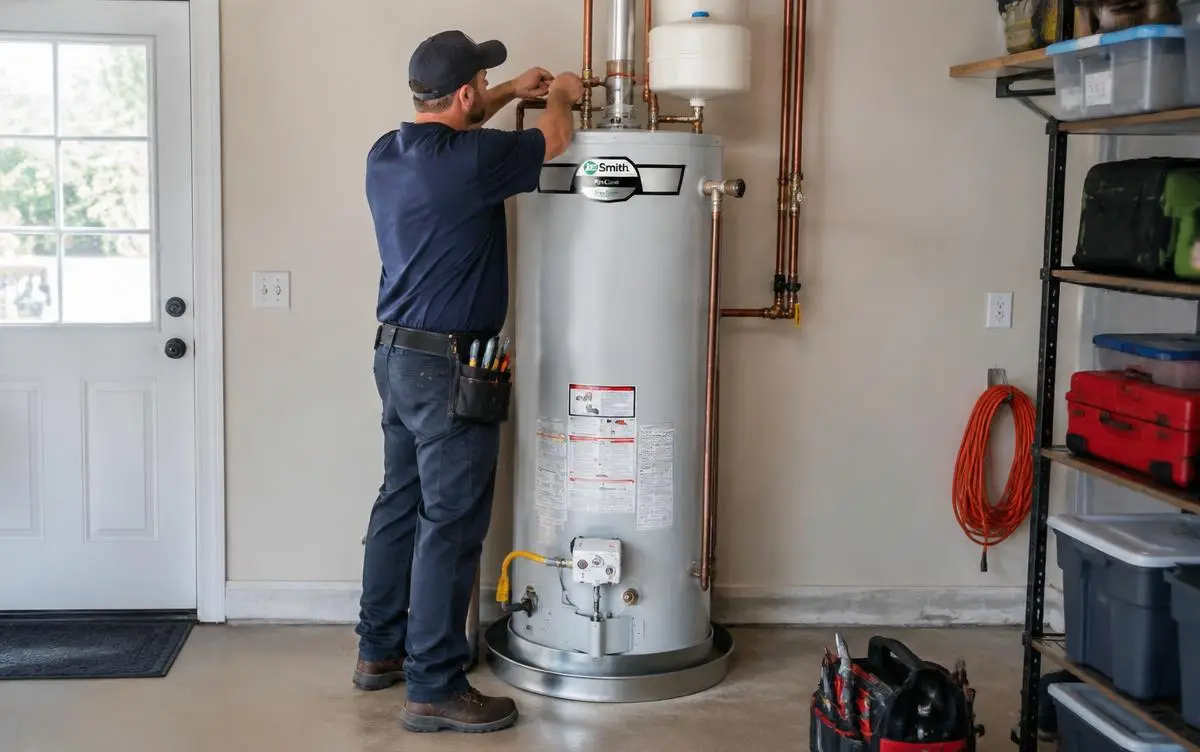
Installed price range for a tankless unit
A switch from tank to tankless often costs more than the unit price alone because of gas line and venting changes. Ask the plumber to inspect your gas meter size and line before quoting.
| Job | Typical range |
|---|---|
| Gas tankless, whole house (install) | $3,000 – $5,500 |
| Electric tankless, whole house (install) | $2,000 – $3,800 |
| Point-of-use tankless (one sink) | $600 – $1,200 |
| Larger gas line upgrade (if needed) | $500 – $1,500 |
| New venting (stainless or PVC) | $400 – $1,200 |
| Annual descale service | $100 – $200 |
Sizing a tankless unit by flow rate
Tankless units are rated in gallons per minute (GPM), not tank size. A typical shower uses about 2 to 2.5 GPM; a kitchen faucet about 1.5 GPM. A whole-house gas tankless unit in Tulsa is usually sized for 7 to 10 GPM to run two showers and a dishwasher at the same time without a temperature drop.
Tankless and temperature rise
Winter groundwater entering a Tulsa home can be near 45 to 50°F, colder than the 60 to 70°F incoming water in summer. A tankless unit has to work harder to reach a 120°F output in winter, which can reduce its maximum flow rate during the coldest months, something to check when sizing for multiple fixtures.
Want a real price for your home?
Get a quoteRecirculation pumps with tankless units
A recirculation pump keeps hot water close to fixtures so there is less wait time, useful in larger homes with distant bathrooms. Adding one to a tankless system typically costs $300 to $800 and may require a compatible tankless model with a built-in recirculation port.
Tankless water heater warranties
| Component | Typical warranty length |
|---|---|
| Heat exchanger | 10 to 15 years |
| Parts | 5 years |
| Labor (if purchased separately) | 1 to 2 years |
Venting requirements in Tulsa homes
Gas tankless units need stainless steel or PVC venting rated for condensing or non-condensing operation, run through an exterior wall or roof. Homes converting from a tank model often need new venting since a standard tank's metal flue is not rated for a tankless unit's exhaust temperature and condensation.
Tax credits and rebates
Some high-efficiency gas tankless models qualify for federal energy tax credits; ask the plumber for the unit's efficiency rating (UEF) before installation if a rebate or credit matters to the budget, since not every model qualifies.
Tankless units and simultaneous fixture use
Running two showers, a dishwasher and a washing machine all at once can exceed even a large whole-house tankless unit's rated flow, causing a temperature drop at the fixture using the least hot water. Families that regularly run several hot water fixtures at once should ask for a higher-GPM model or consider two smaller units installed in parallel.
Tankless installation location options
- Garage wall: common for gas units, keeps the water heater out of living space.
- Exterior wall, outdoor-rated unit: saves interior space entirely but is more exposed to Tulsa's temperature swings.
- Utility closet or basement: shorter pipe runs to main fixtures in some home layouts.
- Attic: possible but less common due to Tulsa summer attic heat, which can stress electronic components faster.
Combining tankless with other plumbing upgrades
Homeowners often schedule a tankless water heater install alongside other plumbing work, such as repiping or a fixture upgrade, since the plumber is already on-site and some wall or attic access overlaps. Doing both at once can reduce total labor time compared with two separate service calls.
A tankless unit paired with a water softener in hard-water areas of Tulsa extends the time between descaling services, sometimes from once a year to every 18 months.
What a tankless quote should include
- Unit model, BTU rating and maximum GPM flow.
- Venting material and route, plus any wall or roof penetration work.
- Gas line upsizing cost, if the existing line is undersized for the new unit.
- Permit cost and whether the plumber pulls it as part of the job.
- Removal and disposal of the old tank water heater.
Replacing a tankless unit at end of life
After 18 to 20 years, a tankless heat exchanger can develop leaks that are not cost-effective to repair, especially once it is out of warranty. Replacement follows the same gas line, venting and electrical checks as a first-time install, though existing venting and gas sizing can sometimes be reused if they still meet the new unit's specifications.
Tankless maintenance schedule
A tankless unit needs an annual descale flush using a vinegar or descaling-solution pump kit connected to the service valves on the unit, a job that takes about 45 minutes. Skipping this flush in Tulsa's hard-water areas lets mineral scale build up on the heat exchanger faster, cutting efficiency and triggering error codes within 2 to 3 years instead of the expected 5.
Most manufacturers void the heat exchanger warranty if a required annual flush was never done and the unit fails from scale buildup, so keep a dated receipt or log each time the flush happens.
Tankless cold water sandwich effect
A tankless unit can deliver a brief burst of cold water between two hot water draws, known as the cold water sandwich effect, if someone turns a faucet off and back on quickly. This is normal tankless behavior, not a defect, and happens because the unit stops heating the instant flow drops below its minimum trigger rate, then restarts a beat behind the new draw.
Switching from tank to tankless: what gets removed
- The old tank is drained, disconnected, and hauled away, usually included in the installation price.
- The old tank's metal flue vent is capped or removed since a tankless unit uses different venting.
- The expansion tank, if the home has one, is evaluated since tankless systems do not need it the same way a tank system does.
- A drain pan under the old tank is no longer needed once the tankless unit is wall-mounted.
Condensing vs non-condensing tankless units
A condensing unit costs more upfront but produces acidic condensate that needs a drain line or neutralizer, while a non-condensing unit skips that extra plumbing but runs a higher monthly gas cost over time.
| Type | Efficiency | Venting |
|---|---|---|
| Condensing | Higher, often 90%+ UEF | PVC venting, needs condensate drain |
| Non-condensing | Lower, often 80–85% UEF | Stainless steel venting, no condensate drain |
Service and descaling after a tankless install
Most tankless repairs cost $150 to $600 depending on the part. A full heat exchanger replacement can run $800 to $1,500 and sometimes costs close to a new unit.
- Error code on the display: most brands print a code chart inside the front cover or on the unit's app.
- Clogged inlet water filter: reduces flow and triggers shutdowns, cleared in about 30 minutes.
- Mineral scale buildup on the heat exchanger: causes error codes and reduced hot water, fixed with a descale flush.
- Frozen outdoor unit: happens during hard freezes if the built-in freeze protection fails or loses power.
- Ignition failure: dirty burner or failed igniter, similar to a tank model repair.
Troubleshooting before calling for tankless service
- Check the display for an error code and write it down before calling.
- Confirm the gas shutoff valve at the unit is fully open.
- Check that the outdoor vent termination is not blocked by snow, leaves or a bird nest.
- Reset the unit per the manufacturer's manual once, since some error codes clear with a simple reset.
- Confirm the breaker for an electric unit, or the igniter battery on a gas unit, has power.
Gas vs electric tankless
A gas tankless unit handles a whole house, including two showers running at once, and needs a 3/4 inch or larger gas line plus outside-rated venting. An electric tankless unit needs a large dedicated circuit, often 2 or 3 of them, and works best for one or two fixtures at a time rather than a whole house in a typical Tulsa home.
| Gas tankless | Electric tankless | |
|---|---|---|
| Installed cost | $3,000 – $5,500 | $2,000 – $3,800 |
| Whole-house capacity | Yes | Limited |
| Needs venting | Yes | No |
| Needs large electrical circuit | No | Yes, often multiple |
| Annual maintenance | Descale flush | Descale flush |
Gas meter and utility coordination
A whole-house gas tankless unit needs more BTU input than a standard 40-gallon tank, sometimes requiring ONG to confirm the gas meter can supply the higher demand. Ask the plumber to check the meter's rated capacity against the new unit's BTU rating before the installation date, since a meter upgrade from ONG can add a week or more to the project timeline if one is needed.
Is tankless right for your Tulsa home
Tankless works well for larger families who run out of hot water with a tank, and for homeowners who plan to stay in the house long enough to recover the higher install cost through 18 to 20 years of use. It works less well in homes with a small gas line, no good outside wall for venting, or very hard water without a softener, since scale builds up faster.
Keeping a tankless unit running in Tulsa
- Flush with a descaling solution once a year, more often with hard water.
- Clean the inlet water filter screen every 6 to 12 months.
- Keep the outdoor vent termination clear of snow, ice and debris in winter.
- Have the burner and igniter checked yearly on gas units.
- Install a water softener if scale buildup happens faster than once a year.
How installation or repair works
- The plumber checks your gas line size, meter capacity or electrical panel space.
- You get a written price including the unit, venting or wiring changes, and the permit.
- Old equipment is removed and the new tankless unit is mounted, usually on an outside or garage wall.
- Gas, water and vent connections are tested, and the unit is fired up and checked for proper flow and temperature.
Tankless water heater near you
This service covers Tulsa, Broken Arrow, Owasso, Bixby, Jenks and Sand Springs. If your tankless unit shows an error code and has no hot water, note the code before calling so the plumber can bring the right part.
A straight swap from an old tankless unit usually takes 3 to 5 hours; a first-time conversion from a tank, with a new gas line and venting, often takes a full day.
Before you book: Tulsa price and problem guides
- Read the tankless water heater cost guide.
Next steps for Tulsa homeowners
Questions Tulsa homeowners ask
How much does a tankless water heater cost installed in Tulsa?
A whole-house gas tankless unit typically costs $3,000 to $5,500 installed, including venting and any gas line upgrade.
Do I need a bigger gas line for tankless?
Often yes. A gas tankless unit needs more gas flow than a tank model, so many installs include a larger gas line, which adds $500 to $1,500.
How long does a tankless water heater last?
About 18 to 20 years with yearly descaling, compared with 8 to 12 years for a standard tank.
Why is my tankless water heater showing an error code?
Common causes are a clogged inlet filter, scale buildup, low gas pressure, or a blocked vent. The code on the display tells the plumber which part to check first.
Does tankless work well with Tulsa's hard water?
It works, but scale builds up faster in hard water areas. A water softener or more frequent descaling keeps the unit efficient.
Can I convert from a tank to tankless myself?
No. This involves gas line sizing, new venting and permits. Hire a licensed plumber so the job meets code.