
Quick checks to find out which drain is clogged
- One slow drain (one sink, tub, or shower): the clog is local to that fixture, usually hair or soap scum.
- Multiple drains slow at once on the same floor: the clog is likely farther down a shared branch line.
- Every drain in the house is slow, or water backs up into a tub when you flush a toilet: this points to the main sewer line, and a plunger will not fix it.
- Gurgling sounds from drains when you run water elsewhere: a sign of a partial blockage or a venting issue further down the line.
- Water backing up into a floor drain or basement fixture: treat this as a main line problem and stop running water until it is checked.
Baking soda and vinegar for a clogged drain: does it work?
Baking soda and vinegar fizz, and the fizz can loosen a thin layer of soap scum or grease near the top of a slow drain. It will not move a hair clog, a wipe, or a grease plug deeper in the line. For a clogged drain that is still slow but draining, pour half a cup of baking soda, then a cup of white vinegar, wait 15 minutes, and flush with a kettle of hot (not boiling) water. If the clogged drain is fully stopped, skip this step and use a plunger or a hand snake.
Chemical drain cleaners: when to skip them
- Skip them on a fully stopped clogged drain. The chemical sits in the pipe and can splash back on you or the plumber.
- Skip them on old galvanized or cast iron pipe, common in pre-1970 Tulsa homes. Repeated use speeds up corrosion.
- Never mix two products, or a chemical cleaner with vinegar. The fumes can be dangerous.
- Enzyme cleaners are slower but safe for pipes and septic tanks. They work best as monthly prevention, not as a fix for a clogged drain.
Want a real price for your home?
Get a quoteTools that clear a clogged drain, and what each costs
If none of these clears the clogged drain, or more than one fixture is backing up at once, the clog is in the main line and needs a plumber with a powered machine or a camera.
| Tool | Best for | Typical price |
|---|---|---|
| Cup plunger | Sinks and tubs | $8 to $15 |
| Flange plunger | Toilets | $10 to $25 |
| Plastic barbed strip | Hair in bathroom sinks and showers | $3 to $8 |
| 25-foot hand snake (auger) | Clogs past the trap | $25 to $50 |
| Wet/dry shop vacuum | Pulling a clog back out of a sink or tub | $60 to $150 |
Bathroom sink clogs vs kitchen sink clogs
Bathroom sink and tub clogs are overwhelmingly caused by hair combined with soap scum, which forms a dense mat in the trap or first few feet of pipe. Kitchen sink clogs more often come from grease that cools and hardens inside the pipe, combined with food particles that stick to that grease layer, which is why hot water alone often cannot fully clear a greasy kitchen line.
How old plumbing affects drain clogs
Homes built before the 1980s in neighborhoods like Midtown and Florence Park sometimes still have galvanized steel drain lines, which corrode internally over decades and narrow the pipe's interior diameter, making clogs more frequent even with normal use. A plumber can confirm pipe material with a camera inspection if clogs keep recurring in an older home.
Garbage disposal and drain clogs
- Fibrous foods like celery, corn husks, and onion skins wrap around the disposal blades and can push debris into the drain line instead of grinding it fully.
- Running cold water, not hot, while the disposal runs helps solidify grease into small pieces that flush through rather than coating the pipe.
- A disposal that hums but does not spin usually has a jam, which can be cleared with the manual reset button and an Allen wrench turned in the bottom center hole, not with fingers.
- A disposal clog can look identical to a kitchen drain clog; if water backs up with the disposal off, the clog is likely downstream of the disposal in the drain line itself.
Cost comparison: snaking vs hydro-jetting vs camera inspection
| Service | What it does | Typical cost |
|---|---|---|
| Cabling/snaking | Cuts through a clog with a spinning cable head | $150 – $450 depending on fixture or main line |
| Hydro-jetting | Scours the full pipe interior with high-pressure water | $300 – $600 |
| Camera inspection | Finds the exact location and cause of a clog or pipe damage | $150 – $300, sometimes credited toward repair |
Seasonal patterns in drain clogs here
Thanksgiving and other holiday cooking weeks see a spike in kitchen drain calls from grease and food scraps poured down the sink during heavy meal prep. Spring, after winter dormancy ends, is when tree roots become most active in seeking out moisture in older sewer lines, making spring a common season for main line backups in neighborhoods with mature trees.
Common causes and fixes
| Cause | Where it happens | Fix | Typical cost |
|---|---|---|---|
| Hair and soap scum | Bathroom sink, tub, shower | Plunge, or pull hair with a zip tool or drain snake | $0 – $15 for a tool, or $150 – $300 professional |
| Grease and food buildup | Kitchen sink | Hot water and dish soap flush, or professional cleaning if hardened | $0 – $20, or $150 – $350 professional |
| Toilet paper or foreign object | Toilet | Plunge; a toilet auger for anything past the trap | $0 – $25, or $150 – $300 professional |
| Tree root intrusion | Main sewer line | Professional cabling or hydro-jetting; camera inspection to confirm | $250 – $600 for cabling |
| Collapsed or bellied pipe | Main sewer line, older clay pipe | Spot repair or full line replacement after camera inspection | $1,500 – $6,000+ |
| Mineral and soap buildup over years | Any drain in an older home | Hydro-jetting to scour the pipe interior clean | $300 – $600 |
Step-by-step: DIY drain clearing
- Step 1: Remove standing water with a cup if the sink or tub is full, so you can see what you are working with.
- Step 2: Try a cup plunger for sinks and tubs, or a flange plunger for toilets. Cover any overflow hole with a wet rag to get a tight seal, then push and pull firmly 15 to 20 times.
- Step 3: If plunging does not work, remove the sink or tub stopper and pull out hair and debris by hand or with a plastic zip tool, wearing gloves.
- Step 4: Use a hand-crank drain snake (auger) for clogs past the trap. Feed it in slowly, turn the crank clockwise, and stop if you feel strong resistance rather than forcing it further.
- Step 5: For a kitchen sink, run hot water for 1 to 2 minutes combined with a squirt of dish soap to help break up grease after removing visible debris.
- Step 6: Avoid chemical drain cleaners as a first step. They can damage older pipes and create a hazard if a plumber later needs to snake the line by hand.
- Step 7: If water is still slow after these steps, or if more than one fixture is affected, stop and call a plumber rather than using stronger chemicals or pushing a snake further.
Safety warnings
Do not mix chemical drain cleaners with each other or use one right after another; the combination can create dangerous fumes. If you already poured a chemical cleaner down the drain, tell the plumber before they start, since it changes how they handle the water that comes back up.
Keep your hand and face away from a garbage disposal at all times, even when it is unplugged; the blades can still move if the switch is bumped. Use a long tool or tongs to remove objects, never fingers.
If sewage backs up into a bathtub or floor drain, avoid contact with the water and keep children and pets away. This is a main line issue that needs a professional, not DIY tools.
When to call a pro
Call a plumber if a plunger and hand snake do not clear the clog, if more than one drain is affected, if water backs up into a different fixture when you run water, or if the clog returns within a few weeks of a DIY fix. A repeat clog in the same spot often means a partial blockage like roots or a sagging pipe section that a cable or camera needs to confirm.
A main line backup is not a wait-and-see problem. Sewage backing up into the house is a health hazard, and continuing to run water can make the mess worse.
When the clog needs a plumber's machine
- A cable machine (snake) run through the branch or main line to cut through roots, grease, and buildup.
- Hydro-jetting for heavier buildup: a high-pressure water jet that scours the full pipe interior rather than just punching a hole through the clog.
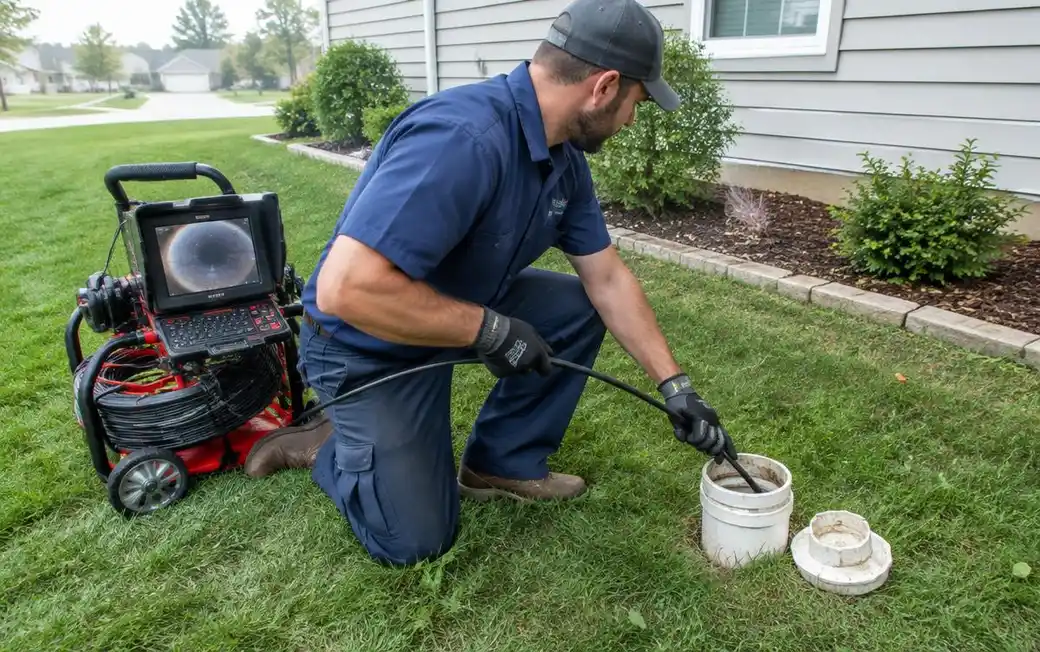
- A camera inspection on repeat clogs or main line issues, to see the exact location and cause before recommending a repair.
- A written estimate before any line replacement, since root intrusion sometimes means a short spot repair rather than full replacement.
How a plumber decides between repair and full line replacement
After a camera inspection, a plumber looks at how much of the pipe shows damage: a short cracked or root-filled section near one spot can often get a spot repair, often without digging up the full yard, using trenchless methods. Pipe that is cracked, bellied, or collapsed along a longer stretch usually needs full replacement, since repeated cabling on a damaged pipe only provides a temporary fix.
Prevention
- Use a mesh drain cover in showers and tubs to catch hair before it goes down.
- Never pour grease down a kitchen drain; let it cool in a can and throw it in the trash.
- Run hot water for 30 seconds after washing dishes to help clear residue before it cools and hardens in the pipe.
- Have your main sewer line cabled or inspected every 1 to 2 years if your home has mature trees near the line or is older than 40 years.
- Avoid flushing wipes, even ones labeled flushable; they do not break down like toilet paper and are a leading cause of toilet and main line clogs.
Why sewer lines clog more here
Homes in older neighborhoods often still have clay or cast iron sewer lines, and clay pipe joints are a favorite entry point for tree roots looking for moisture, especially in a summer that regularly tops 95°F with dry stretches between rains. Expansive clay soil also shifts seasonally, which can crack aging pipe joints and create the low spots, or bellies, where paper and waste collect and cause repeat clogs even after cabling.
In older Oklahoma homes with cast iron drains, scale and roots make repeat clogs more likely than in PVC lines. A plumber usually clears a single sink or tub clog in under an hour. Ask whether the price includes a 30-day warranty if the same drain clogs again.
Next steps for Tulsa homeowners
Questions Tulsa homeowners ask
Why does my drain clog again a few weeks after I clear it?
A repeat clog in the same drain often means a partial blockage, like roots or a sagging pipe section, that cabling only cuts through temporarily. A camera inspection finds the real cause.
Is it safe to use a chemical drain cleaner?
Occasional use in a healthy pipe is usually fine for a minor clog, but repeated use can damage older metal pipes and creates a hazard for anyone who later has to snake the line by hand.
What is the difference between cabling and hydro-jetting?
Cabling cuts a path through a clog with a spinning blade. Hydro-jetting uses high-pressure water to scour the entire inside of the pipe clean, which works better on grease and long-term buildup.
Why do all my drains back up when I flush the toilet?
This points to a blockage in the main sewer line downstream of where the branch lines join. It needs professional cabling or a camera inspection, not a plunger.
How much does professional drain cleaning cost?
A single fixture drain cleaning typically runs $150 to $300. Main line cabling runs $200 to $450, and hydro-jetting runs $400 to $900.
Can tree roots really get into a sewer pipe?
Yes. Roots grow toward the moisture and nutrients in a sewer line and enter through small cracks or joint gaps, especially in older clay pipe, then grow into a dense mass that traps paper and waste.
Should I keep plunging if it is not working after a few tries?
If 15 to 20 firm plunges do not improve drainage, stop and try a hand snake or call a plumber rather than repeating the same approach for a long time.