
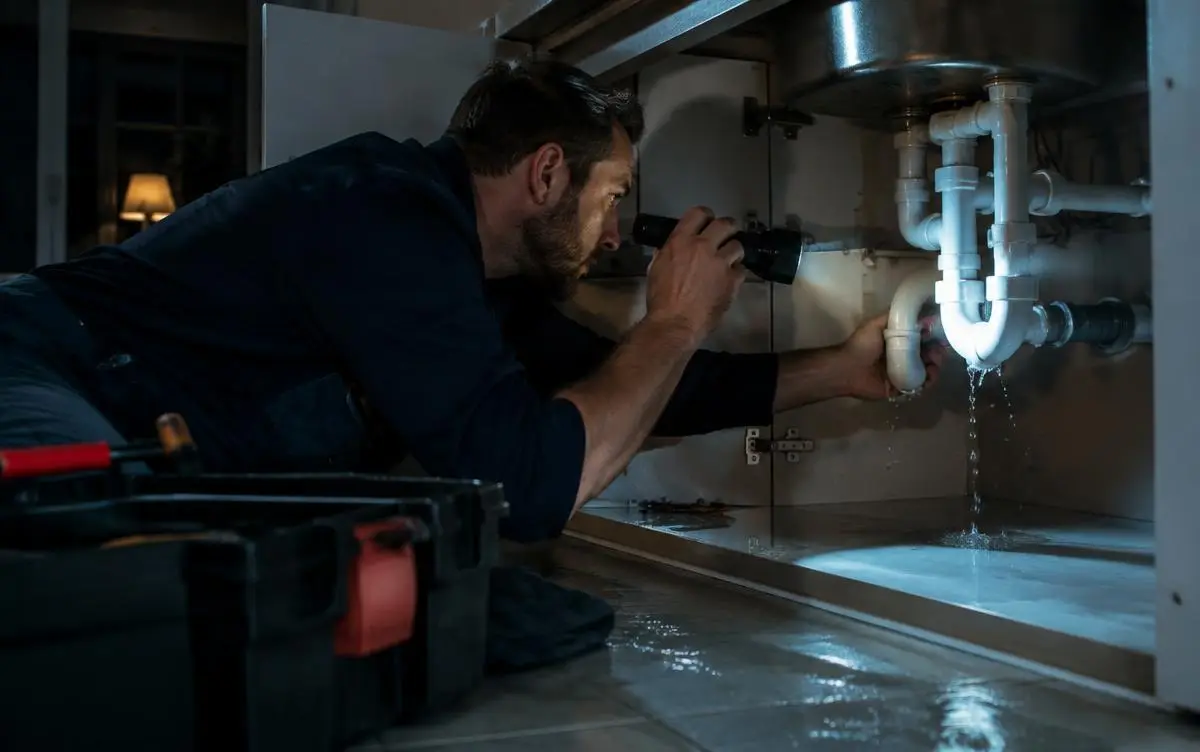
Frozen pipes? Quick checks when you suspect one
- Turn on a faucet. No water, or just a trickle, with no other plumbing problem usually means a freeze somewhere between the meter and that faucet.
- Check faucets fed by exterior walls first: kitchen sinks on outside walls, bathroom faucets above a garage, and any outdoor hose bibb.
- Look and feel along exposed pipe in a crawlspace, basement, or garage for frost, bulging, or a section that feels unusually cold.
- Check for a damp spot, drip, or sagging ceiling or wall, which can mean a pipe has already split and is leaking once it starts to thaw.
- If you find a split or bulge, locate your main water shut-off valve now before doing anything else, even if the pipe has not yet started leaking.
How insurance usually handles a burst pipe
Most homeowners policies cover sudden water damage from a burst pipe, including drywall, flooring, and cleanup, but not the frozen pipe itself if the home was found unheated during the loss. Many policies require the thermostat to be kept at a minimum temperature, often 55°F or higher, or that someone checked the house regularly if it was vacant. Photograph the damage and the burst section before repairs begin, and keep the receipt from the plumber for the claim.
Heat tape: what it is and how to use it
- Heat tape is an electrical cable wrapped along exposed pipe that warms the pipe surface during cold weather.
- Self-regulating heat tape adjusts its own output based on temperature and is safer for unattended use than older constant-wattage tape.
- Plug heat tape into a GFCI outlet, never a standard extension cord, to reduce shock and fire risk in a damp crawlspace.
- Inspect heat tape yearly for cracked insulation or exposed wire before the cold season starts; damaged tape is a fire hazard and should be replaced, not taped over.
- Heat tape typically costs $20 to $60 for a 10 to 30 foot roll, plus the cost of an electrician if a new GFCI outlet is needed nearby. Check the package rating before buying, since some tape is built only for roof de-icing and is not rated for direct contact with water supply pipe.
Want a real price for your home?
Get a quoteCauses and fixes
| Cause | Fix | Typical cost |
|---|---|---|
| Uninsulated pipe in exterior wall, attic, or crawlspace | Add foam pipe insulation or heat tape before winter | $1 – $3 per foot of insulation |
| Hose bibb left connected with hose attached | Disconnect hoses, install a frost-free hose bibb | $100 – $250 installed |
| Thermostat set too low in a vacant or rental house | Keep heat at 55°F or higher at all times in winter | $0, cost of heating |
| Cabinet doors closed on sink against an exterior wall | Open cabinet doors during hard freezes to let room heat reach the pipe | $0 |
| Pipe already split from freezing | Shut off water, thaw carefully, then repipe the damaged section | $150 – $500 per split section |
| Crawlspace vents left open in winter | Close foundation vents before freezing weather | $0 – $50 for vent covers |
Step-by-step: thawing a frozen pipe safely
- Step 1: Keep the faucet connected to the frozen section open. This relieves pressure as the ice melts and gives melted water somewhere to go.
- Step 2: Find the frozen section. It is usually the coldest exposed point between the shut-off valve and the open faucet; look where pipe runs along an exterior wall or through an unheated space.
- Step 3: Warm the pipe gradually with a hair dryer on low heat, moving it along the pipe rather than holding it in one spot, or wrap the pipe with towels soaked in hot water.
- Step 4: Start warming from the end closest to the open faucet and work back toward the blockage, so melted water has a path out rather than building pressure behind ice.
- Step 5: Keep warming until water flow returns to normal at the faucet, then check the full length of exposed pipe again for drips, since a hairline split can be hard to spot until it thaws fully.
- Step 6: If you cannot find the frozen section, or it is inside a wall you cannot access, stop and call a plumber rather than opening drywall yourself.
Safety warnings
Never use an open flame such as a blowtorch, propane torch, or charcoal lighter to thaw a pipe. This is one of the leading causes of house fires during cold snaps, since pipe is often near wood framing and insulation.
Do not use a space heater unattended near a crawlspace or inside a confined area to thaw pipes. If you must use one, stay with it and keep it away from any flammable material.
If a pipe has already split, shut off the main water valve before you leave the area to get tools. A frozen pipe can hide the leak until it thaws and then release a large amount of water quickly, sometimes faster than you can respond.
If water reaches an electrical outlet, panel, or any wiring, turn off power at the breaker before doing anything else, and do not stand in water while touching electrical components.
When to call a pro
Call a plumber if you cannot locate the frozen section, if the pipe is inside a wall or ceiling, if you find a split or bulge in the pipe, or if water does not return after 30 to 45 minutes of careful warming. Call immediately, day or night, if water is actively leaking; plumbers in this network take emergency calls for exactly this situation during cold snaps.
During a widespread freeze event like the Feb 2021 cold wave, when temperatures stayed below zero for days, plumbers get a high volume of frozen and burst pipe calls at once. Calling as soon as you notice a problem, rather than waiting, gets you in the queue sooner.
What a plumber does for frozen or burst pipes
- Locates the frozen or split section, often using a thermal camera for pipe hidden in walls.
- Thaws the pipe with professional-grade heating equipment designed for safe, even heat.
- Cuts out and replaces any split or cracked pipe section with copper or PEX.
- Checks nearby fittings and valves for hairline cracks that may not leak until later.
- Recommends insulation, heat tape, or rerouting for pipe that froze due to poor placement.
Frozen pipes questions homeowners ask first
- At what temperature do pipes freeze? Frozen pipes are a risk in attics, crawlspaces, and outside walls when the outdoor temperature stays near 20°F or lower for several hours.
- How long does it take pipes to freeze? An unprotected pipe in a cold crawlspace can freeze in 6 to 8 hours of hard cold.
- Should you shut off the water? If you suspect frozen pipes and cannot find the spot, close the main valve before thawing. A burst pipe floods only when the ice melts.
- Should you open the faucets? Yes. Open the faucet on the frozen line so melting water and steam can escape, which lowers pressure in the pipe.
- Will frozen pipes thaw on their own? They will when the weather warms, but slow thawing gives you no control over a crack. Thaw them yourself with gentle heat, or call a plumber.
Signs frozen pipes have already cracked
Any of these after frozen pipes means a leak. Shut the main valve and call a plumber about the frozen pipes before the drywall soaks through.
- Water hissing or dripping inside a wall or ceiling once the pipe thaws.
- A wet spot, bulge, or stain on drywall near an outside wall.
- The water meter dial still spinning with every faucet off.
- Low pressure at one fixture after the rest of the house is back to normal.
Prevention before the next freeze
- Disconnect all garden hoses from outdoor faucets before the first freeze of the season.
- Install foam pipe insulation sleeves on any exposed pipe in a crawlspace, garage, or attic.
- Let faucets farthest from the main shut-off drip a pencil-thin stream of water during hard freezes; moving water resists freezing.
- Keep the thermostat at 55°F or higher at all times during winter, even if you travel.
- Seal gaps around pipe penetrations in exterior walls and the foundation with caulk or spray foam to block cold air from reaching pipe runs.
- Close crawlspace vents before winter and open them again in spring for ventilation.
Crawlspace and slab homes: different freeze risks
Homes on a pier-and-beam foundation with an open or vented crawlspace freeze fastest, since cold air moves freely under the floor and around supply lines. Homes on a concrete slab rarely freeze at the slab itself, but a slab home's pipes running through an uninsulated garage wall or attic above the garage are still exposed the same as any other home.
Mobile and manufactured homes have supply lines running through a skirted underbelly that is often thinly insulated from the factory. Owners of these homes should check the belly wrap each fall for tears or gaps that let cold air reach the pipe before the first hard freeze.
What to do before you leave town in winter
- Set the thermostat no lower than 55°F for the entire trip, not just overnight.
- Shut off the main water valve and open a few faucets to drain the lines if you will be gone more than a week during peak winter.
- Ask a neighbor to check the house every few days during an extended cold snap and report any dripping, pooling, or low water pressure.
- Leave cabinet doors under sinks on exterior walls open before you leave, so room heat can reach the pipe the entire time you are away.
- Unplug any temporary space heaters you were using to protect crawlspace pipe; leaving one running unattended for days is a fire risk.
Why Oklahoma winters cause this
Winters here run mild most of the season with sudden hard freezes, including nights in the teens or lower, and the rare extreme event like February 2021 that dropped well below zero for multiple days. Because severe cold is not constant, many homes are built with less pipe insulation than homes in colder climates, which is exactly why a short, sharp freeze catches exposed pipe in garages, crawlspaces, and exterior walls off guard across the Tulsa, Broken Arrow, Owasso, Bixby, Jenks, and Sand Springs area.
If a burst pipe is repaired, ask the plumber for a labor warranty on the joint and photos of the damage for your insurance claim.
Next steps for Tulsa homeowners
- Ready to fix it? emergency plumber in Tulsa — a licensed local pro calls back with a price.
- See leak detection.
- See slab leak repair.
- See whole-house repiping.
- See our slab leak repair cost guide.
Questions Tulsa homeowners ask
How long does it take for pipes to freeze in a hard freeze?
An uninsulated pipe exposed to wind and cold below the mid-20s°F can freeze in as little as 6 to 8 hours, faster if there is already low flow through it.
Should I leave a faucet dripping during a freeze warning?
Yes, a pencil-thin stream from the faucet farthest from your main shut-off helps relieve pressure and keeps water moving so it resists freezing.
What do I do if a frozen pipe already burst?
Shut off the main water valve immediately, then call a plumber. Do not try to thaw a pipe you know is already split, since that releases water right away.
Can I use a hair dryer to thaw a pipe?
Yes, a hair dryer on low heat moved along the pipe is a safe way to thaw exposed pipe. Never use an open flame or torch.
How much does it cost to fix a burst pipe from freezing?
A single split section repair typically runs $150 to $500. Costs rise if drywall needs to be opened and patched or if multiple sections failed.
Does homeowners insurance cover frozen pipe damage?
Many policies cover sudden water damage from a burst pipe, but check your specific policy; some require proof you kept the home heated to a minimum temperature.
Where do pipes freeze most often in this area?
Exterior wall sections behind kitchen and bathroom cabinets, unheated garages, attics above conditioned space, and crawlspaces with open vents are the most common spots.