
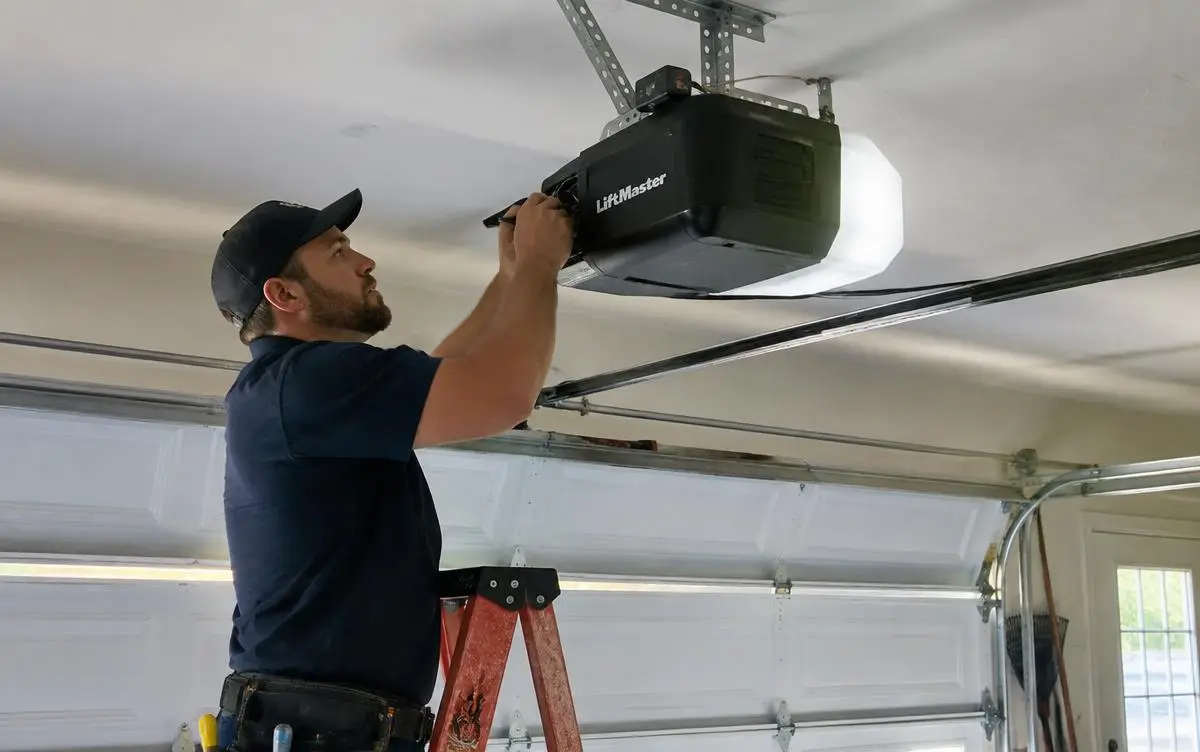
Garage door opener not working? Quick checks first
- Look at the opener motor unit on the ceiling. If no lights are on at all, it likely has no power.
- Check that the opener is plugged into the outlet, and check the breaker for that circuit in your panel.
- Replace the battery in the remote and in the wall button or keypad if it uses one; weak batteries cause intermittent response before they fail fully.
- Look at the two small sensor eyes near the floor on each side of the door track. If either light is not solid, or something is blocking the invisible beam between them, the opener will refuse to close.
- Try the wall-mounted button inside the garage. If the wall button works but the remote does not, the issue is the remote, not the opener itself.
- Listen for a humming sound with no door movement, which usually points to a stripped drive gear or a problem in the motor, not the remote or sensors.
Causes and fixes
| Cause | Fix | Typical cost |
|---|---|---|
| No power to the opener | Check outlet, breaker, and cord; reset breaker if tripped | $0 |
| Dead remote or keypad battery | Replace battery | $5 – $10 |
| Misaligned or blocked safety sensors | Realign sensors so both lights are solid, clear obstructions | $0 – $20 |
| Remote out of program with the opener | Reprogram remote following the opener's learn-button steps | $0 |
| Stripped internal drive gear | Replace the gear kit inside the motor unit | $100 – $200 |
| Worn drive belt or chain | Replace the belt or chain | $120 – $250 |
| Failed circuit board or logic board | Replace the circuit board, or replace the whole opener if old | $150 – $350, or $300 – $600 new opener |
| Opener motor burned out | Replace the opener unit | $300 – $600 installed |
Garage door opener not working: match the symptom
- Garage door opener not working at all, wall button and remotes do nothing, no lights: power. Check the outlet, breaker and GFCI.
- Garage door opener not working from the remote only, wall button works: replace the remote battery, then reprogram it with the Learn button.
- Door only closes while you hold the wall button: safety sensors are blocked or out of line.
- Lights work, motor hums, door does not move: possible broken spring, stuck door or bad capacitor.
- Trolley moves along the rail but the door stays: the trolley is disengaged. Pull the release cord toward the door to reconnect.
- Grinding noise, chain or belt does not move: stripped drive gear, a common repair costing $120 to $250.
- Door opens only part way: travel limits or force settings need adjusting, or a spring is weak.
Want a real price for your home?
Get a quoteWi-Fi and smart opener problems
Smart garage door openers that connect to a phone app add their own failure points separate from the motor itself. A router restart, a changed home Wi-Fi password, or an app update can all break the connection without affecting the opener's wall button or physical remote at all. If the physical remote and wall button both work but the app does not, the issue is the Wi-Fi module or your network, not the opener's motor or gears.
Battery backup units built into many newer openers can fail silently after a few years; if the opener stops working during a power outage but worked fine before, the backup battery likely needs replacing, typically a $30 to $60 part.
Step-by-step diagnosis
- Step 1: Check for a light on the opener unit itself. No light at all means a power problem; check the outlet with another device, then the breaker.
- Step 2: If there is power, press the wall button inside the garage. If the door moves, the opener works and the problem is with your remote or keypad.
- Step 3: Replace the remote's battery and try again. If it still fails, try reprogramming it using the learn button on the opener motor, following the model's instructions, usually printed inside the cover.
- Step 4: If the wall button also does nothing, check the two sensor eyes near the floor on each side of the door. Wipe off any dust or cobwebs, and make sure nothing (a bike, a box, a leaning ladder) sits in the beam path.
- Step 5: Gently adjust one sensor bracket if the lights are not both solid, since even a slight bump can knock them out of alignment.
- Step 6: If the door tries to move but stalls or reverses, check the drive chain or belt for slack or damage, visible by looking along the rail above the door.
- Step 7: If you hear the motor hum but see no movement in the trolley along the rail, the issue is likely internal to the motor unit and needs a technician.
Rolling code and remote programming issues
- Modern openers use a rolling security code that changes with each use; a remote stored too long unused, or one that was out of range during a learn-mode reset, can fall out of sync.
- Universal remotes sometimes need a specific programming sequence that differs from the original manufacturer remote; check the opener's model number before assuming the remote is defective.
- A keypad that lets you in with the wrong code, or not at all, may need its 4-digit PIN reset through the opener's learn button, not just a battery swap.
- If every remote in the house stopped working at once, suspect the opener's circuit board or antenna rather than each individual remote.
Safety warnings
Do not disable or unplug the safety sensors to force the door to close. They exist to stop the door from closing on a person, pet, or vehicle, and bypassing them removes that protection entirely.
If the opener's internal gears, belt, or motor need replacing, this involves working inside a housing near the drive mechanism and sometimes near the garage door springs if the opener shares a mounting bracket area. Leave this to a technician rather than opening the motor housing yourself.
If the door reverses unexpectedly or will not stay closed, do not leave it in a partially open position and walk away; this is a security risk, and children or pets can get under it.
Unplug the opener before doing any hands-on inspection near the drive rail or trolley, even if you are only looking, in case it activates unexpectedly.
When to call a pro
Call a garage door technician if power and sensor checks do not restore function, if you hear grinding, humming, or clicking without door movement, if the belt or chain looks frayed or loose, or if the opener is more than 10 to 15 years old and keeps failing intermittently. An opener that age often has worn internal gears that are not worth repairing piece by piece.
If your home uses the opener as the main way in and out of the garage, treat a non-working opener as a same-day repair, especially if you cannot easily operate the door manually due to a disconnected release or a heavy door.
What a technician checks on an opener call
- Voltage at the outlet and the opener's internal transformer to confirm steady power.
- Sensor alignment with a laser or visual check, and wiring continuity to each sensor.
- Drive mechanism condition: belt, chain, or screw drive for wear, slack, or stripped teeth.
- Circuit board function, testing wall button and remote signals separately to isolate the fault.
- Door balance and spring tension, since an opener working against an unbalanced door burns out faster.
- Remote and keypad programming, resetting codes if several remotes are out of sync.
How to reset a garage door opener
Unplug the opener for one minute, then plug it back in. This clears many errors after a power surge. If remotes stopped working, press and hold the Learn button on the motor until the light goes off to erase all codes, then press Learn once and press your remote within 30 seconds.
If your garage door opener not working problem returns after a reset, write down the number of light blinks or the error code and give it to the technician.
When a garage door opener not working means replacement
- Your garage door opener not working is the third repair in two years, or the opener is over 15 years old or was built before 1993, when safety sensors became required.
- The circuit board has failed and the part costs more than half of a new opener.
- You want battery backup, which keeps the door working during Tulsa storm outages.
Opener types and how troubleshooting differs
| Opener type | Common point of failure | Typical fix cost |
|---|---|---|
| Chain drive | Chain stretches or jumps off the sprocket | $80 – $180 for chain and adjustment |
| Belt drive | Belt frays or slips after 8 – 12 years | $100 – $200 for belt replacement |
| Screw drive | Drive screw dries out and binds, or the nut wears | $90 – $180 for lubrication or nut replacement |
| Wall-mount (jackshaft) | Mounting bracket shifts, throwing off cable tension | $120 – $250 to realign and re-tension |
DIY sensor fix vs. when it's actually the opener
Realigning sensors is one of the few garage door fixes safe to do yourself: loosen the wing nut or screw holding the sensor bracket, adjust until both LED lights glow solid, then retighten. If the lights stay solid but the door still will not close by remote, the problem has moved past the sensors and likely sits in the circuit board or wiring, which calls for a technician rather than more adjustment of the brackets.
Prevention
- Replace remote and keypad batteries once a year, even before they die completely.
- Keep the area near the floor sensors clear of stored items, bikes, and tools.
- Lubricate the drive rail with the manufacturer's recommended lubricant twice a year; avoid WD-40, which attracts dust.
- Test the auto-reverse safety feature monthly by placing a roll of paper towels in the door's path and confirming it reverses on contact.
- Have the opener's belt or chain tension checked yearly, since a loose chain causes jerky movement that speeds up gear wear.
Why this fails more often in this region
Garages here see wide temperature swings, from summer heat above 95°F in an attached garage to winter lows in the teens, and that range stresses plastic gears and belt materials over time. Garages also collect dust and pollen through open doors much of the year, which settles on the safety sensor lenses and is one of the most common, easily fixed causes of an opener that suddenly stops responding.
Summer heat in Oklahoma can shorten remote batteries and warp sensor brackets on sun-facing garages. Most new openers carry a motor warranty of several years; check yours on the label on the motor housing before buying a replacement.
Next steps for Tulsa homeowners
Questions Tulsa homeowners ask
Why does my garage door opener hum but not move the door?
This usually points to a stripped internal drive gear or a stuck trolley on the rail, not a remote or sensor problem, and typically needs a technician to open the motor unit.
Why do the sensor lights matter if I just want the door to close?
The opener is designed to refuse to close if the sensor beam is broken or misaligned, as a safety feature to prevent closing on a person or object. It will not close until both lights are solid.
My remote stopped working but the wall button is fine. What does that mean?
The opener itself works, so the issue is isolated to the remote: a dead battery or a remote that fell out of program with the opener's receiver.
How much does it cost to fix a garage door opener?
Simple fixes like batteries or sensor alignment cost nothing to very little. Gear, belt, or circuit board repairs run $100 to $300. A full opener replacement runs $300 to $600 installed.
Is it worth repairing an old opener or should I replace it?
If the opener is over 10 to 15 years old and the motor or circuit board has failed, replacement is usually a better value than paying for parts on an aging unit.
Can I realign the safety sensors myself?
Yes, this is a simple DIY step: loosen the mounting screw slightly, adjust the sensor until its light is solid, and retighten. No tools beyond a screwdriver are needed.
Will a power outage affect my garage door opener's memory?
Some openers lose their remote programming or clock settings after a power outage. If remotes stop working right after an outage, try reprogramming them first.