
Garage door won't open? Quick checks before you touch anything
Standard garage doors weigh 130 to 400 pounds and rely on spring tension to counterbalance that weight so the opener motor, which is not strong enough to lift the door alone, can do its job. When the door will not open, the cause is almost always spring tension, a blocked sensor, or power.
- Look at the springs above the door. A visible gap in the coil means a broken spring, and the door should not be forced open by hand or opener.
- Check the two small safety sensors near the floor on each side of the track. If either light is not solid (usually green), something is blocking the beam or they are misaligned.
- Replace the remote battery and try the wall-mounted button directly; if the wall button works but the remote does not, the issue is the remote, not the opener.
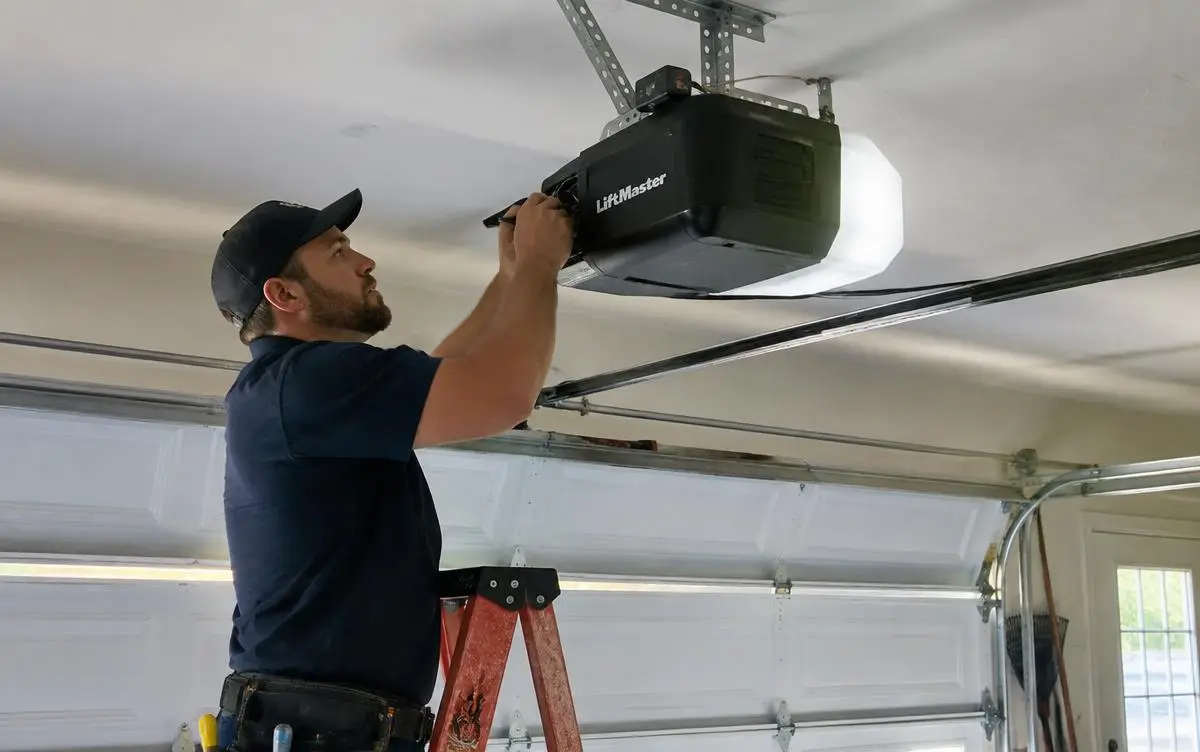
- Look at the opener's motor unit on the ceiling for a blinking light, which usually signals an error code explained in the manual.
- Check if the door was manually locked with a slide lock bar on the inside, common on older doors.
- Confirm the opener is plugged in and the outlet has power; a tripped breaker can cut power to just the opener circuit.
Causes and fixes
| Cause | Fix | Typical cost |
|---|---|---|
| Broken torsion spring | Replace spring pair | $250 – $450 |
| Misaligned or dirty safety sensor | Clean lens, realign sensor brackets | $0 – $100 |
| Dead remote or wall button battery | Replace battery | $5 – $15 |
| Broken cable | Replace cable, inspect spring | $100 – $250 |
| Opener motor or circuit board failure | Repair or replace opener | $150 – $500 |
| Door off track | Realign rollers and track | $125 – $300 |
| Locked slide bolt engaged | Disengage lock bar | $0 |
| Stripped or worn drive gear in opener | Replace drive gear | $80 – $150 |
| Power outage or tripped breaker | Restore power or reset breaker | $0 |
Step-by-step: what to do right now
- Step 1: Look at the springs above the door before trying anything else. A visible gap means stop; do not use the opener or pull the emergency release.
- Step 2: If springs look intact, check both safety sensor lights near the floor. Wipe each lens with a soft cloth and make sure nothing, including a leaf or a toy, sits in the beam path.
- Step 3: Gently bend the sensor brackets so both lenses point directly at each other if one light is not solid.
- Step 4: Try the wall button. If it works, replace the remote's battery; if it does not, check the breaker panel.
- Step 5: Look up at the opener's motor head for a blinking light and check the manual or a label on the unit for what the blink count means.
- Step 6: If the door is stuck closed and you need the car out, and the springs looked intact, use the emergency release cord per the opener's instructions, then lift manually with help, since a 130 to 400 pound door needs two people.
- Step 7: If springs are broken or you are not confident lifting it manually, wait for a technician rather than forcing it.
Want a real price for your home?
Get a quoteSafety warning: springs and cables are not DIY
A standard residential torsion spring is wound with 30 or more turns of tension and can break fingers, fracture bones, or cause serious eye injury if it releases while being handled without the right winding bars and clamps. Never attempt to adjust, wind, or replace a torsion spring yourself.
Never place hands or feet under a moving door, and keep children away from a door with any suspected spring or cable issue, since it can drop without warning once tension is uneven.
When to call a pro
Call a garage door technician the same day if a spring is broken, if a cable looks frayed or snapped, or if the door will not move even manually. A stuck-closed door can trap a car inside, and a stuck-open door is a security and weather risk. Most garage door companies treat a non-opening door as a priority same-day call.
Get the price in writing before work starts, and ask if it covers both springs if one is broken, since springs installed together typically wear at a similar rate.
What a technician does
- Checks spring tension and condition, and winds or replaces springs with the correct size for the door's weight.
- Inspects and replaces cables showing fraying at the drum or bottom bracket.
- Realigns or replaces safety sensors and tests the beam with a hand pass test.
- Tests opener motor voltage, drive gear condition, and circuit board function.
- Lubricates rollers, hinges, and the track, and checks for bent sections.
- Cycles the door multiple times by hand and with the opener to confirm smooth, balanced travel.
What a stuck-door fix usually costs
| Job | Typical price |
|---|---|
| Service call and diagnosis | $75 – $125 |
| Sensor alignment or cleaning | $0 – $100 |
| Torsion spring pair replacement | $250 – $450 |
| Cable replacement | $100 – $300 |
| Opener repair | $150 – $350 |
| Opener replacement, installed | $300 – $600 |
Prevention
- Test the safety sensors monthly by waving an object through the beam while closing the door; it should reverse immediately.
- Keep the sensor area clear of leaves, cobwebs, and stored items that can block the beam.
- Have springs and cables inspected once a year, ideally before summer heat and before winter cold.
- Lubricate rollers, hinges, and the track every 6 months with garage door lubricant, not WD-40.
- Replace both springs together once one shows age or wear past 7 years, rather than waiting for a snap.
Temperature swings and clay soil in this area
Summers above 95°F and winter lows in the teens put real stress on garage door steel and lubricant, and the first cold snap each year, often in November, is a common time for a marginal spring to finally break. Homes built on expansive clay soil, common across the Tulsa area, can see slight foundation and slab movement over the years that pulls a track slightly out of square, adding extra friction that strains the opener and springs.
Questions to ask before hiring a garage door technician
Ask for the spring size and cycle rating being installed, since a higher cycle-rated spring, often 10,000 cycles versus 100,000, can cost slightly more but last years longer. Confirm whether the quoted price includes both springs if replacing one, whether the service call fee applies to the repair, and whether the technician carries liability insurance for work on your property.
More reasons a garage door won't open
- If the garage door won't open and nothing lights up, start here. Tripped breaker or GFCI outlet: check the breaker panel and press reset on any GFCI outlet in the garage.
- Manual slide lock: a metal bar on the inside of the door can be slid into the track by accident. Slide it back.
- Lock or vacation mode: many wall buttons have a lock button that blocks remotes. Press and hold it to turn it off.
- Disconnected trolley: if someone pulled the red release cord, the opener runs but the door stays put. Reconnect the trolley.
- Limit settings: after a power surge, an opener can lose its travel limits. The motor runs a moment, then stops.
- Stripped drive gear: the motor hums or runs but the chain or belt does not move. This is a common repair on openers over 8 years old.
- Remote interference: LED bulbs and some security systems can block the remote signal. Try the wall button and swap to a garage-rated LED bulb.
Garage door won't open in cold weather
In a Tulsa ice storm, the bottom seal can freeze to the driveway. If the garage door won't open on a frozen morning, do not keep pressing the button, since the opener can tear the seal or strip its gear. Melt the ice along the seal with a hair dryer or warm (not boiling) water, then try again. If the garage door won't open even after the ice is gone, check the springs. Grease on the tracks and rollers also thickens in the cold and makes the door slow.
How to open a garage door from the outside
If the power is out and the garage is your only door in, an outside emergency release kit lets you pull the trolley release with a key lock on the top panel. Kits cost about $20 to $40 and take about 30 minutes to fit. Without one, you cannot safely open an automatic door from outside.
If the garage door won't open because a spring broke, do not lift it by hand from outside. With no spring holding the weight, a double door can weigh 150 to 250 pounds.
Choosing a garage door opener replacement
If the opener itself has failed rather than the spring or cable, modern replacement openers run on belt or chain drives, with belt drives running quieter, which matters for garages attached to a bedroom. Many newer openers include battery backup and smartphone alerts, worth asking about when comparing a repair cost to a full opener replacement.
Insurance and homeowner considerations
Most homeowners insurance does not cover a garage door spring or cable failure, since it is treated as normal wear. Coverage is more likely if a specific event, like a storm or a vehicle collision, caused the damage. Check your policy and take photos before any repair if you plan to file a claim.
Power outages and backup battery options
Ice storms in this region occasionally knock out power for hours, which stops an electric opener from working at all; the manual emergency release lets you open the door by hand during an outage, as long as the spring is not broken. Some newer opener models include a battery backup, worth asking about if outages are a regular concern in your neighborhood.
Oklahoma temperature swings stretch and tighten springs over time, which is one reason springs fail on the first cold morning. Ask the technician for the cycle rating of new springs and how long the parts and labor warranty runs.
Next steps for Tulsa homeowners
- Ready to fix it? book a garage door repair — a licensed local pro calls back with a price.
- See garage door cable repair.
- See our spring replacement cost guide.
- See snapped cable.
Questions Tulsa homeowners ask
Why won't my garage door open with the remote or wall button?
Check the safety sensor lights near the floor first; a blocked or misaligned sensor is one of the most common causes, along with a dead remote battery.
Can I open my garage door manually if the opener fails?
Yes, using the emergency release cord, but only if the spring looks intact. With a broken spring, the door can be too heavy and unsafe to lift by hand.
How much does it cost to fix a garage door that won't open?
Simple fixes like sensor cleaning or a battery cost $0 to $15. A broken spring repair runs $150 to $300. Opener repairs run $100 to $300.
Is a broken garage door spring an emergency?
Treat it as urgent. A door with a broken spring can be unsafe to operate, and most companies offer same-day service for this.
Why do both my garage door sensors show green but the door still won't move?
If sensors are clear, check the spring for a visible gap, check the opener's breaker, and look for a blinking error light on the motor unit.
Can cold weather cause a garage door to stop working?
Yes. Cold stiffens springs, lubricant, and plastic opener gears, and the first hard freeze of the season is a common time for failures.
Should I replace both garage door springs at once?
Most technicians recommend it if one spring is broken and both were installed at the same time, since the second is usually close to failing too.