
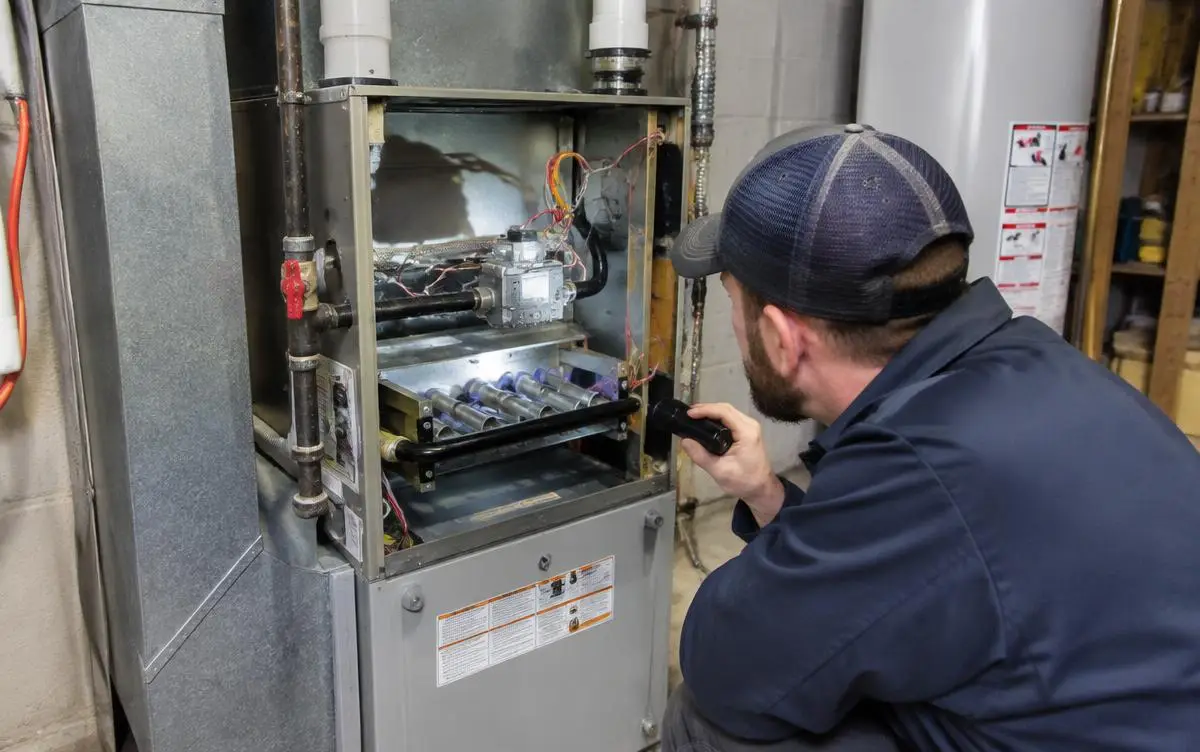
Furnace not turning on? Quick checks before calling anyone
- Check the thermostat display. If it is blank, replace the batteries, usually two AA or AAA cells, then set the temperature 5 degrees above room temperature.
- Check the breaker panel for the furnace circuit and the switch that looks like a light switch near the furnace itself, often mounted on or near the unit.
- Open the furnace door and check the filter. A filter clogged with dust blocks airflow enough to trip a safety limit switch that shuts the furnace down.
- Check the condensate line if you have a high-efficiency furnace. A clogged line trips a float switch that stops the furnace to prevent water damage.
- If you have a gas furnace, check the gas valve is in the on position and that ONG has not shut off gas service to the house.
- Look for a flashing light on the furnace control board through a small window on the panel. Count the flashes; the furnace manual lists what each count means.
Furnace not turning on: 8 checks in order
- Before anything else with a furnace not turning on: thermostat set to Heat, set 3 to 5 degrees above room temperature, with fresh batteries.
- Furnace power switch on. It looks like a light switch on or near the furnace and is often turned off by mistake.
- Breaker not tripped. Reset it once. If it trips again, stop and call.
- Furnace door panel closed tightly. A safety switch behind the panel keeps the furnace off when the door is loose.
- Air filter clean. A clogged filter can overheat the furnace and trip the high-limit switch.
- Gas valve open. The handle should run in line with the gas pipe.
- Condensate drain clear (high-efficiency furnaces). A full drain pan or blocked trap stops the furnace through the pressure switch.
- Status light code. Count the blinks on the control board through the small window and match them to the chart on the door.
Furnace starts, then shuts off
If the burners light for a few seconds and then go out, the flame sensor is usually dirty. A technician cleans or replaces it for about $100 to $250. If the inducer fan runs but the burners never light, the problem is often the igniter, the pressure switch or the gas valve.
A furnace not turning on after several reset attempts can lock itself out for an hour. A furnace not turning on is rarely fixed by repeated resets, so note the blink code and call.
Want a real price for your home?
Get a quoteWhen a furnace not turning on is an emergency
- You smell gas (rotten eggs): leave the house, then call ONG or 911 from outside.
- A carbon monoxide alarm sounds: get everyone outside and call 911.
- Indoor temperature drops below about 55°F with infants, older adults or anyone with health problems in the home.
- Pipes on outside walls may freeze: open cabinet doors and drip faucets until the furnace not turning on problem is fixed.
Pilot light vs. electronic ignition furnaces
Older furnaces, often installed before the mid-1990s, use a standing pilot light that must be relit by hand with a specific button sequence printed on the furnace panel if it blows out; a pilot that will not stay lit usually points to a failing thermocouple, a roughly $20 to $75 part. Newer furnaces use electronic hot surface ignition or intermittent spark ignition instead, with no pilot light to relight, so a no-heat problem on these units points to the ignitor, flame sensor, or control board rather than a blown-out flame.
Furnace age and when replacement makes more sense than repair
| Furnace age | Typical guidance |
|---|---|
| Under 10 years | Repair almost any issue; parts are usually available and the unit has years left |
| 10 – 15 years | Repair for costs under $500; consider replacement for a failed heat exchanger or control board |
| 15 – 20 years | Compare repair cost to roughly half the price of a new furnace before deciding |
| Over 20 years | Most technicians recommend replacement, since efficiency is lower and parts get harder to find |
Causes and fixes
| Cause | Fix | Typical cost |
|---|---|---|
| Dead thermostat batteries | Replace batteries | $5 – $10 |
| Tripped breaker or switch off | Reset breaker, confirm furnace switch is on | $0 |
| Clogged air filter | Replace filter | $15 – $30 |
| Clogged condensate drain line | Clear the line, replace float switch if stuck | $100 – $250 |
| Failed ignitor or flame sensor | Clean or replace ignitor or sensor | $150 – $350 |
| Bad thermostat | Replace thermostat | $120 – $300 installed |
| Failed control board | Replace control board | $300 – $700 |
| Gas valve closed or gas outage | Reopen valve; call ONG for outage | $0 – $150 |
| Blower motor or capacitor failure | Replace motor or capacitor | $200 – $600 |
Carbon monoxide: signs beyond the detector
A carbon monoxide detector is the main defense, but also watch for soot near the furnace cabinet, a yellow or flickering burner flame instead of steady blue, excess moisture on windows near the furnace room, or a stale, heavy smell when the furnace runs. Headaches or nausea that improve when you leave the house and return when the furnace runs are a warning sign, not a coincidence to ignore.
If a carbon monoxide detector sounds, leave the house immediately with everyone inside, call 911 or the fire department from outside, and do not re-enter until it is cleared. Have the heat exchanger inspected before running the furnace again.
Step-by-step diagnosis
- Step 1: Set the thermostat to heat mode and raise it well above room temperature. Listen for a click within 10 seconds.
- Step 2: If nothing happens, check the breaker panel. Flip any tripped breaker fully off, then back on.
- Step 3: Find the furnace service switch, usually a toggle on a nearby wall or on the furnace cabinet, and confirm it is in the on position.
- Step 4: Pull out the air filter and hold it up to a light. If you cannot see light through it, replace it before doing anything else.
- Step 5: Open the furnace door panel. Many furnaces will not run unless this panel's safety switch is fully engaged, which needs the door seated correctly and latched.
- Step 6: Look for the condensate line, a plastic tube running from a high-efficiency furnace to a drain or outside. If it is full of water and a small float switch nearby has triggered, the line needs clearing.
- Step 7: If the furnace clicks and briefly ignites but shuts off, note that pattern. It usually means a weak flame sensor, which is a common and inexpensive repair.
- Step 8: If none of this restores heat, stop testing gas components and call a technician.
Safety warning
Never bypass a safety switch to force a furnace to run. These switches exist to prevent gas leaks, overheating, and carbon monoxide buildup. If you smell gas near the furnace at any point, do not flip any switches, including the light switch. Leave the house and call ONG's gas emergency line at 1-800-458-4251 from outside.
Do not remove the furnace door panel and reach near the burner assembly while the unit is running. Gas furnaces have an open flame and hot surfaces during operation. Leave ignitor, gas valve, and control board work to a licensed HVAC technician.
When to call a pro
Call an HVAC technician if the breaker trips again after resetting it, if you smell gas, if the furnace clicks repeatedly without lighting, or if the filter and thermostat checks do not restore heat. A technician brings a multimeter and manometer to test gas pressure, ignitor resistance, and control board signals that cannot be checked safely without tools.
In winter, a furnace failure during a cold snap is an emergency, especially with lows in the teens overnight in this region. Most HVAC companies prioritize no-heat calls and can often get to a home the same day in winter months.
What a technician does on a no-heat call
- Tests voltage at the thermostat, transformer, and control board to find where the signal stops.
- Checks the flame sensor with sandpaper or a multimeter and cleans or replaces it if the signal is weak.
- Tests the ignitor for continuity; a hot surface ignitor that does not glow orange is usually cracked or burned out.
- Clears the condensate line and tests the float switch.
- Checks gas pressure at the manifold with a manometer to confirm the furnace is getting the right gas volume.
- Inspects the heat exchanger for cracks, which is a safety issue that can leak carbon monoxide.
Thermostat settings that commonly cause a no-heat call
- Mode switch left on "cool" or "off" instead of "heat", which is an easy miss on programmable and smart thermostats.
- Fan switch set to "on" instead of "auto", which can mask whether the furnace is actually firing or just blowing room-temperature air.
- Schedule programs that override a manual temperature change, pulling the set point back down a few minutes after you raise it.
- A smart thermostat stuck in a low-power or offline mode after a Wi-Fi outage, which stops it from sending a call for heat to the furnace.
Electric furnaces and heat pump air handlers
Homes without gas service often use an electric furnace or a heat pump with electric backup heat strips instead of a gas furnace. These units have no pilot light, ignitor, or gas valve to check, so a no-heat call usually comes down to the breaker (often a double-pole breaker rated 40 to 60 amps), the heat strip relays, or the blower motor.
An electric furnace that runs the blower but produces no heat often has one or more failed heating elements or a tripped high-limit switch, both of which need a technician with a multimeter to test safely.
Prevention
- Replace the filter every 1 to 3 months during heating season; a $15 filter prevents several of the common shutdown causes above.
- Schedule a furnace tune-up each fall before the first cold snap. A tune-up checks the ignitor, flame sensor, and heat exchanger before they fail.
- Keep the area around the furnace clear of boxes and laundry; restricted airflow around the unit causes overheating shutdowns.
- Install a carbon monoxide detector near sleeping areas if your home does not already have one; this is cheap protection against a cracked heat exchanger.
- Replace thermostat batteries every fall when you change filters, so a dead battery never looks like a furnace failure.
Why this happens more in this region
Winters here swing from mild to below zero within days, and furnaces that sit mostly idle for 8 months can have a buildup of dust on the ignitor or a stuck condensate float that only shows up on the season's first real cold night. The Feb 2021 cold wave, with days below zero, pushed many older furnaces and control boards past their limits at once, which is part of why fall tune-ups catch problems before winter demand peaks.
Oklahoma cold snaps fill HVAC schedules within a day, so do the free checks before the forecast drops. If the furnace is under 10 years old, look up its parts warranty by serial number before paying for an igniter or flame sensor out of pocket.
Next steps for Tulsa homeowners
- Ready to fix it? book a furnace repair visit — a licensed local pro calls back with a price.
- See our furnace replacement cost guide.
- See heat pump vs. furnace comparison.
Questions Tulsa homeowners ask
Why does my furnace do nothing when I turn up the thermostat?
Check thermostat batteries and settings first, then the breaker and the furnace's own power switch. These three checks solve a large share of no-heat calls.
My furnace clicks but does not light. What does that mean?
This usually points to a dirty or weak flame sensor, or a failing ignitor. Both are common, inexpensive repairs for a technician.
Is it safe to reset the breaker more than once?
Reset it once. If it trips again immediately, stop and call a technician; a breaker that keeps tripping points to an electrical fault, not something to keep resetting.
How much does a furnace repair typically cost?
Simple fixes like a flame sensor or filter run $15 to $350. Bigger repairs like a control board or blower motor run $300 to $700.
Can a dirty filter really stop the furnace from running at all?
Yes. A severely clogged filter can overheat the furnace and trip a limit switch that shuts the whole unit down as a safety measure.
Should I smell gas when my furnace is working normally?
No. A brief, faint smell during ignition can be normal, but any ongoing or strong gas smell means you should leave and call ONG at 1-800-458-4251.
How fast can someone come out for no heat in winter?
Many HVAC companies treat no-heat calls as priority and offer same-day service in cold months, though it depends on local demand during a cold snap.