
Garage door cable snapped? Quick checks before you touch anything
A garage door cable carries real force. Standard doors weigh 130 to 400 pounds, and the springs and cables share that weight between two sides. When one cable snaps, the other side takes the full load and can fail next within days if the door keeps getting used.
- Look at the door. If it is stuck halfway or sitting crooked with one side low, the door is unsafe to touch by hand.
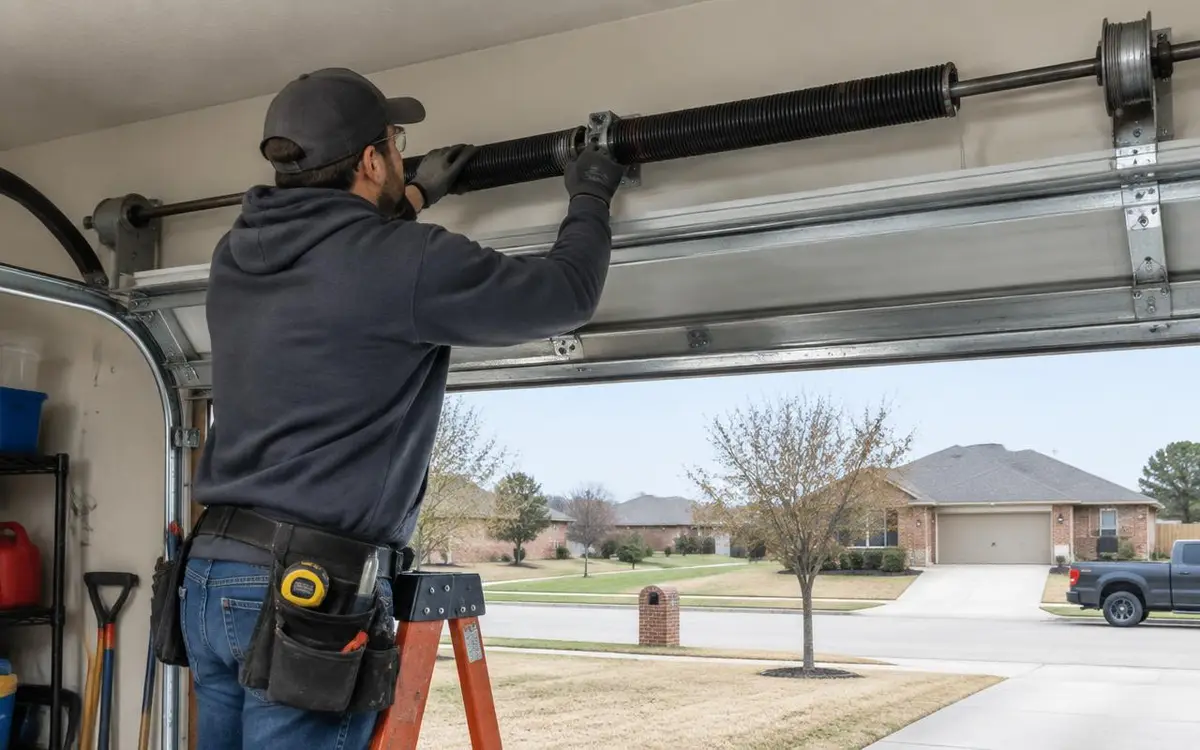
- Check both torsion springs above the door. A broken spring shows a clear gap in the coil. A broken spring is almost always why a cable snapped, since the cable then carries the full weight of the door alone.
- Look at the cable drums at each end of the torsion shaft. A cable that jumped off a grooved drum, or a drum with a chipped groove, will shred the cable in minutes of use.
- Check the bottom roller brackets, where the cable loops and clamps. A rusted or bent bracket is a common break point on doors older than 10 years.
- Do not pull the emergency release cord while the door is unbalanced. With one cable gone, the door can fall fast once released.
One-car vs. two-car doors: what changes
A single-car door typically uses one torsion spring and two cables, one on each side of the same shaft. A two-car door usually has two torsion springs working together, or occasionally extension springs along the horizontal tracks instead. Extension spring systems use a separate safety cable run through the spring itself; if that safety cable is missing when a spring breaks, the spring can become a projectile, which is one more reason to leave spring and cable work to a technician.
Why garage door cables snap
| Cause | How it happens | Typical fix cost |
|---|---|---|
| Broken torsion spring | Spring loses tension or snaps, cable takes the full door weight and frays or snaps | $250 – $450 (springs, both sides) |
| Worn, frayed cable | 7 to 15 years of daily cycles wear the cable strands at the drum and bottom bracket | $100 – $200 per side |
| Bent or chipped cable drum | A dented drum cuts the cable on the sharp edge over repeated cycles | $120 – $250 including drum and cable |
| Rusted bottom bracket | Moisture and age weaken the bracket, it cracks and the cable loop pulls free | $100 – $200 |
| Door off-track or hit by a car | Impact bends the track, pulls the cable off the drum and kinks or snaps it | $150 – $400 depending on track damage |
| Wrong cable length or gauge installed | A past repair used the wrong cable, which stretches unevenly and fails early | $100 – $200 to replace with correct cable |
Want a real price for your home?
Get a quoteLift cables vs safety cables: which one snapped?
A torsion spring door has two lift cables, one on each side, running from the bottom bracket up to a drum on the spring bar. If a lift cable snapped, the door hangs crooked or drops on one side. An extension spring door also has safety (retaining) cables running through the middle of each spring. If a safety cable snapped, the door may still work, but a spring that breaks later has nothing to stop it from flying across the garage.
Either way, a garage door cable snapped means the door is out of balance. Do not use the opener until a technician checks it. When a garage door cable broke on one side, that side drops and the door hangs crooked; the other cable is the same age and usually close to failing, so replace both.
Extension springs vs. torsion springs and cables
| Spring type | Where it's mounted | Cable role |
|---|---|---|
| Torsion spring | Horizontal shaft above the door, center or both sides | Cables wind onto drums at each end of the shaft to lift the door evenly |
| Extension spring | Stretched along the horizontal tracks above the door | Cables and pulleys connect the spring's pull to the bottom door brackets |
How long cables and springs typically last
- Torsion springs are rated in cycles, commonly 10,000, often lasting 7 to 10 years with average use of 3 to 4 cycles a day.
- Cables typically match the spring's lifespan since they share the same load and wear schedule.
- A household that opens the garage door more than 6 to 8 times a day, common with teenagers or a home office with frequent deliveries, shortens that lifespan noticeably.
- A door that squeaks, sags on one side, or feels heavier than usual to lift by hand (with the opener disconnected) is nearing the end of spring and cable life.
Step-by-step: what to do right now
- Step 1: Unplug the garage door opener at the outlet so no one tries to run the door by remote.
- Step 2: Keep kids and pets away from the door. A door with one cable can shift or drop without warning.
- Step 3: Do not try to force the door up or down by hand. The remaining spring and cable are under high tension and can release suddenly.
- Step 4: If the door is open and blocking your only way to get a car out, leave it and use another exit if you have one, rather than forcing the door closed.
- Step 5: Take a photo of the spring and the cable near the drum with your phone flashlight. This helps a technician bring the right size parts on the first visit.
- Step 6: Call a garage door technician rather than attempting the repair yourself, for the safety reasons below.
Safety warning: this is not a DIY repair
A torsion spring on a standard 7-foot residential door is wound with 30 turns or more of tension, enough to break fingers, fracture bones, or cause blindness if it slips off a winding bar. A cable under that tension can whip hard enough to cause a deep cut. Garage door technicians use winding bars, vise grips, and clamps rated for this exact job, and they train specifically on spring tension.
If you have a two-car door with two springs, one broken spring often means the second is near the end of its life too. Most technicians replace both at once since they were installed the same day and wear at a similar rate. Replacing only one leaves mismatched tension, which strains the new cable right away.
What a technician actually does
- Releases remaining spring tension safely with winding bars before touching the cable.
- Removes the damaged cable and drum, and inspects the opposite side for wear.
- Installs new galvanized aircraft cable sized to your door's weight and track length.
- Replaces or rewinds the torsion spring to match the door's exact weight, measured with a scale, not guessed.
- Reattaches cables to the bottom brackets, tests the balance by hand with the opener disconnected, then reconnects the opener.
- Cycles the door 5 to 10 times to confirm smooth, even travel on both sides.
When to call a pro
Call a garage door technician the same day the cable snaps. A door that is stuck open is a security and weather risk, and a door stuck closed can trap a car inside. In Tulsa, a technician can usually get to you the same day or next morning for a snapped cable, since it is one of the most common emergency calls garage door companies get.
Get a written price before work starts. Ask whether the quote includes both cables, both springs if needed, and a full safety inspection of the rollers and hinges while the door is apart.
Garage door cable cost breakdown
| Job | Typical price |
|---|---|
| Service call and diagnosis | $75 – $125 |
| One cable replaced | $100 – $200 |
| Both cables replaced | $150 – $300 |
| Torsion spring pair replaced | $250 – $450 |
| Cable plus spring plus drum | $250 – $550 |
| New bottom brackets | $80 – $160 |
Garage door cable snapped with the door open or closed
- Door closed: leave it closed, unplug the opener and use another door. This is the safest position.
- Door open: do not stand or park under it. If a car is inside, back it out slowly only if the door is clearly held up and not tilting. Otherwise wait for the technician.
- Door stuck halfway: keep people and pets away. Clamp locking pliers on the track under a roller on each side if you can do it without standing under the door.
- If a garage door cable snapped and also caused a spring to break, the job usually costs $300 to $550 for springs and cables together.
Why a garage door cable snapped twice
If a garage door cable snapped again within a year of repair, look for a cause the first technician missed: a cracked or grooved drum, a rusted bottom bracket, a bent track that makes one side bind, or springs that are too weak so the cable carries shock loads. Ask the second technician to check all four.
Preventing a snapped cable
- Have springs and cables inspected once a year, ideally in spring before summer heat adds strain.
- Keep the tracks and rollers lubricated with garage door lubricant, not WD-40, every 6 months.
- Watch for a door that looks crooked when opening, moves in jerks, or makes a loud bang. These point to early wear before a full snap.
- Replace both springs together if one is original and over 7 years old, even if it has not failed yet.
- Keep the door balanced: a properly balanced door stays in place when disconnected from the opener and lifted halfway by hand.
What happens if you ignore a snapped cable
A door left with one working cable will drop unevenly if anyone tries to operate it, often jamming in the track or bending a roller bracket, which adds repair cost beyond the original cable and spring. Forcing an opener to keep trying against a jammed, unbalanced door can also burn out the opener's motor or strip its drive gear, turning a $150 to $500 cable and spring repair into a $300 to $600 opener replacement as well. Waiting also risks the door falling the rest of the way while someone is standing or parked underneath it, which is the main reason technicians treat a snapped cable as a same-day call rather than a scheduled one.
Clay soil and temperature swings in this area
Garages in this region see summer heat above 95°F and winter lows in the teens. That swing stiffens steel springs and cables in cold weather, which is when a marginal cable is most likely to snap, often on the first cold morning in November or December. Attached garages built on expansive clay soil can also see slight foundation shifts that pull tracks slightly out of alignment over years, adding extra strain on one cable before the other.
Oklahoma wind gusts can push a door with one broken cable off its track, so keep it closed until it is fixed. Ask for the cable and drum replacement to come with a written labor warranty, and ask whether the springs were checked at the same visit.
Next steps for Tulsa homeowners
Questions Tulsa homeowners ask
Can I drive my car out if a cable snapped while the door is open?
Only if the door is fully open and stable, and you can confirm by eye that it is not sagging on one side. If it looks crooked, do not pull the car under it; the door could drop.
How much does it cost to fix a snapped garage door cable?
A single cable replacement typically runs $100 to $200. If a broken spring caused the snap, expect $250 to $550 for cable, spring, and inspection together.
Can I replace a garage door cable myself?
It is not recommended. The cable is tied directly to a wound torsion spring under heavy tension, and releasing or working near that tension without the right tools has caused serious injuries.
Why did my cable snap if it looked fine?
Cable wear happens on the inside, where it wraps the drum, which you cannot see without removing it. A broken spring overloading the cable is the most common hidden cause.
How long does a cable repair take?
Most cable and spring repairs take 45 minutes to 90 minutes once the technician arrives, depending on whether both sides need new cables and springs.
Will my garage door opener fix itself if the cable is replaced?
If the opener motor and circuit board were not damaged by trying to force the door, yes. Test the opener only after cable and spring repair is complete.
Is a snapped cable covered by homeowners insurance?
Usually not, since it is considered wear and maintenance. It may be covered if a specific event like a car collision caused it. Check your policy.